




Obasa removal will be reclassified as a resignation.
Meranda will also step down to maintain balance of power in the state.
President not enthused about Ex-Speaker, but he was upset at being caught off guard by impeachment
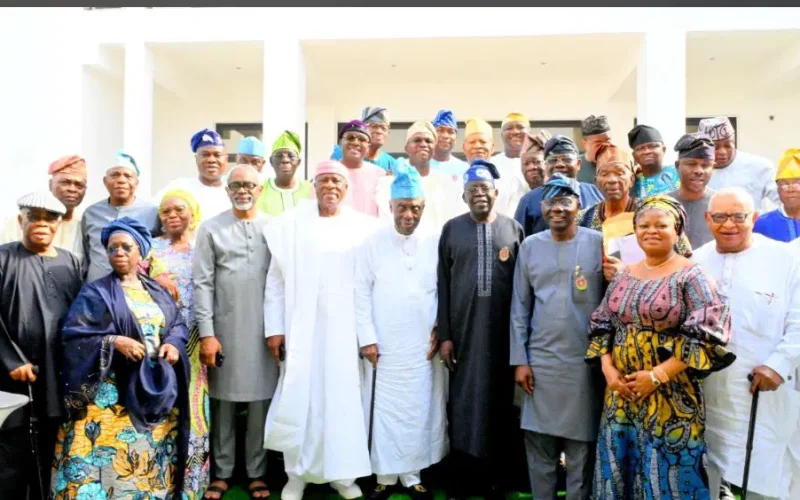
Subsequent to weeks of negotiations and notwithstanding a pending court case regarding the removal of Mudashiru Obasa as Speaker of the Lagos State House of Assembly, President Bola Tinubu and several leaders of the All Progressives Congress (APC) arrived at a political solution over the weekend, deemed advantageous to all parties involved.
Sources at the Presidential Villa intimated that President Tinubu had received visits from various prominent party leaders, including former APC National Chairman Chief Bisi Akande, former Governor of Ogun State Olusegun Osoba, Minister of Solid Minerals Mr. Dele Alake, and a host of others.
A source disclosed that, prior to the meeting between the president and the party leaders, a prominent Nigerian and nonagenarian from the South-west (name withheld) had met with the president to discuss the Assembly matter and other national concerns.
The nonagenarian requested that the president consider his plea regarding Lagos as a birthday gift.
The President met with various stakeholders regarding the Lagos Assembly matter, with each assessing the potential consequences of allowing the situation to deteriorate further. Despite the damage already inflicted, the consensus was that Obasa’s removal was permanent, given the explicit laws governing the Assembly’s election and removal of a Speaker.
Notably, virtually everyone who commented on the Assembly crisis expressed strong disapproval of Obasa’s leadership and conduct during his tenure. They contended that, considering the widespread opposition from 37 out of 39 colleagues, as well as the state’s political leaders’ rejection of him, reinstating Obasa would be contrary to the dominant view.
It was the opinion of the president’s team that removing Obasa would have severe political repercussions for the state and would undermine the president’s democratic credstruggle
Consequently, the president decided at the meetings that Obasa’s removal was irreversible, but a request was made to salvage his political future by providing him with a soft landing.
To facilitate this soft landing, it was decided during the meetings that Obasa’s removal would be commuted to resignation, similar to the case of Hon. Funmi Tejuosho, a former deputy speaker of the Assembly.
Once this matter was settled, the focus shifted to the fate of the current speaker, Hon. Mojisola Meranda. The president found this decision challenging, particularly given the speaker’s gender.
According to the source, while the president sought to promote women in state politics, the speaker’s origins in the same senatorial district as the governor, Lagos Central, made it impossible for her to retain her position.
One of the arguments presented was that, with the governor and deputy governor hailing from Lagos Central and East respectively, it was essential to include Lagos West in the power dynamics, especially considering the Assembly’s leadership crisis.
The source revealed that the president was deeply concerned and inquired about the possibility of finding another woman from Lagos West to take the speaker’s position, thereby avoiding allegations of discrimination against women in the power struggle.
The Lagos State House of Assembly has been embroiled in a leadership crisis, prompting a series of high-level meetings to resolve thsolution
According to a source familiar with the developments, the situation arose from the removal of Obasa as Speaker, a decision that caught President off guard. The source explained that the president’s displeasure stemmed not from any personal affinity for Obasa, but rather from the perceived discourtesy of being unaware of the removal. The president’s response, suggested that Obasa’s inability to maintain the trust of his colleagues was a personal failing, rather than a reflection of the president’s influence.
Furthermore, the source noted that Obasa’s lengthy tenure as Speaker, which spanned over nine years, was seen as sufficient compensation for his services.
The meeting concluded that Meranda should also resign and allow someone from Lagos West to assume the speakership position, ensuring that none of the three senatorial districts felt marginalized.
Ultimately, the President adopted a forward-looking approach, focusing on finding solutions rather than dwelling on past grievances. The source revealed that the president’s newfound disposition enabled the collective identification of a solution.


