




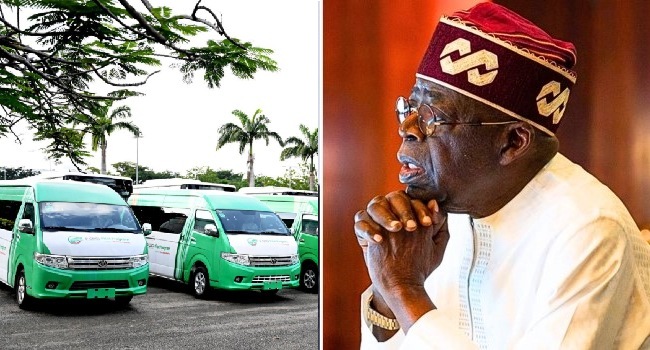
President Bola Tinubu has directed states to accelerate the implementation of the National Affordable CNG Transit Programme, with the goal of delivering measurable reductions in transportation costs to more Nigerians from October 1, 2026.
Tinubu disclosed this in a statement on Saturday, saying the initiative was agreed upon with the 36 state governors during a meeting on August 27.
He said an implementation committee had subsequently been established under the auspices of the Nigeria Governors’ Forum, chaired by Governor AbdulRahman AbdulRazaq of Kwara State.
“I am aware of the considerable work already underway by the committee, PI-CNG & EV, the states, and other critical stakeholders to identify priority transport corridors, determine appropriate interventions, and put the necessary arrangements in place,” Tinubu said.
“This work has become even more urgent amid the current global energy crisis.”
CNG For Lower Transport Costs
The President highlighted examples from states where the deployment of CNG and electric-powered transport had already resulted in lower fares for commuters.
In Borno, he said, CNG-powered and electric public transport services carry commuters for between ₦50 and ₦100 on routes where commercial operators charge between ₦300 and ₦600.
He said that in Kaduna, 100 CNG-powered buses provide free transportation on major routes.
According to Tinubu, the buses carried about 3.2 million passengers during their first year of operation, saving commuters more than ₦3.5 billion in transport costs.
In Oyo, the deployment of CNG buses to Pacesetter Transport reduced the Lagos–Ibadan fare from about ₦8,000 to ₦3,200 during the initial deployment, he said.
Tinubu also cited reductions in Adamawa, where he said alternative-energy transit services had cut fares by as much as 50 per cent, from ₦8,000 to ₦4,000, and in Enugu, where the deployment of 100 CNG buses reduced the Enugu–Nsukka fare from ₦2,500 to ₦1,500.
He said that government-supported buses transport about 13,000 commuters daily in Plateau at ₦200, compared with more than ₦500 commercially.
The President said that through a partnership with the National Union of Road Transport Workers, passengers using CNG-converted commercial vehicles on several Abuja commuter routes were also benefiting from fare reductions of 40 per cent.
Tinubu said the Area 1–Gwagwalada fare had fallen from ₦1,500 to ₦900, Nyanya from ₦700 to ₦420, and Wuse from ₦400 to ₦240.
He further disclosed that in Niger, passengers on the Suleja–Abuja route pay ₦550 compared with about ₦800, while Abia had deployed 40 electric buses with fares subsidised by 50 per cent.
“These are not projections. Nigerians are already experiencing these savings,” the President said.
120,000 Vehicles Converted
Tinubu said the Federal Government had spent the past three years developing a CNG transportation ecosystem across the country, with more than 120,000 vehicles already converted.
He added that Nigeria now has more than 400 certified conversion centres and over 90 CNG refuelling stations, with both figures increasing daily.
The President said the current global energy crisis, which is putting pressure on petrol and diesel prices and transportation costs worldwide, made the expansion of cheaper alternatives more urgent.
“Disruptions to global energy supplies are once again pressuring petrol and diesel prices and increasing transportation costs worldwide,” he said.
“Nigeria cannot control events in global energy markets. But as a gas-rich nation, we can reduce our exposure.”
Tinubu said the government would continue supporting the expansion of CNG infrastructure and access, conversion capacity and participation by states, transport operators, manufacturers and private investors.
He also urged states to work with transport unions and commercial operators, support vehicle conversion and fleet deployment, and facilitate the infrastructure required.
“Above all, ensure that savings from cheaper energy reach Nigerian citizens through lower fares,” he said.
“Nigeria has the gas. We are building the infrastructure. We are already seeing the savings,” The President added Tinubu said Nigeria must move faster and scale this so more Nigerians feel those savings in the fares they pay every day.
‘Let Nigerians Breathe’
Tinubu’s comment comes after former Vice President, Atiku Abubakar, on Friday urged him to take immediate steps to reduce the cost of petrol.
Speaking at a press briefing in Abuja on fuel prices, palliatives and the cost of living, Atiku warned that Nigerians are already struggling under the combined burden of high energy, transportation and food costs.
He said Nigerians had continued to bear the effects of the removal of the petrol subsidy since May 2023, without adequate protection for families, workers, farmers and businesses.
Atiku, who is the presidential candidate of the African Democratic Congress (ADC) in the 2027 general elections, said the impact of higher petrol prices had spread across the economy, with increased transportation and logistics costs pushing up the prices of food and other necessities.
“When government makes energy expensive, it makes life expensive,” Atiku said, urging Tinubu to “let Nigerians breathe”.