





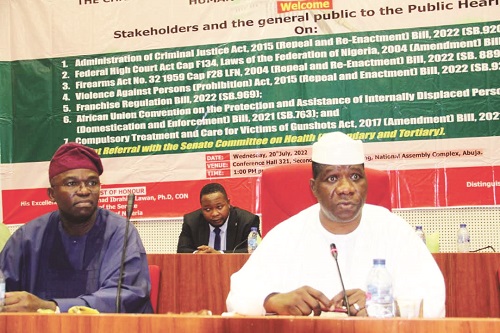
Two bills sponsored by the Chairman, Senate Committee on Industries and the Senator representing Lagos East Senatorial District. Mukhail Adetokunbo Abiru, – The Federal High Court Act (Amendment) Bill, 2021 and The Franchise Regulation Bill, 2022 were among seven bills that the Senate Committee on Judiciary, Human Rights and Legal Matters, led by Senator Opeyemi Bamidele (Ekiti Central), considered at a public hearing on Wednesday.
Senate President, Dr. Ibrahim Lawan, who was represented by the acting Senate Leader, Senator Ajayi Borrofice (Ondo North), declared the hearing open.
Senator Bamidele in his welcome address, appreciated all invited stakeholders who turned up for the event urging them to make necessary inputs into the bills so that the nation’s body of law is enriched with the bills which are all high impact legislations.
Abiru, who is the Chairman of the Senate Committee on Industries while presenting a synopsis of the two bills, pointed out that the bill that seeks to amend the Federal High Court Act to address the obvious shortcomings inherent in the Principal Act to make provisions for the regulation of the award of pre-judgment interest to ensure the attainment of substantial justice, particularly in relation to claims bothering on commercial transactions.
He said that in commercial claims, particularly the ones for recovery of debts, the claimant should ordinarily be entitled to prejudgment interest on the principal debt sum should he succeed in his claim. However, entitlement to such a pre-judgment interest is not as easy as it seems, at least as far as the numerous decisions of our appellate courts are concerned.
“Presently in Nigeria, there is no statutory law which regulates the award of pre-judgment interest. Nigerian courts up till date still have recourse to the English common law practice as a guide in their award of pre-judgment interest.
“A legislation and legal framework is desirable to deal with the glaring shortcomings in the law and practice on award of pre-judgment interest and this is the reason he came up with the bill”, Abiru, said at the hearing.
On the Franchise Regulation Bill 2022, Abiru stated that the bill seeks to create a framework for the regulation of franchising and to guide the relationship between franchisors and franchisees and for matters connected therewith.
He said: “Franchising is a well-utilised model used for business expansion by both multinationals and local businesses. With the growth of consumerism, markets for goods and services are becoming increasingly globalised. Franchising provides a means of expanding the reach of a business into new territories and new markets in a lower risk model than traditional company owned expansion. Franchising in Nigeria has evolved over the years from not being properly utilised and understood to now being employed across various sectors.
“However, as of today, there is no single statute that regulates franchising or guides the relationship between franchisors and franchisees. Since there are no laws the basic principles of contracts and intellectual property law are applied to franchises in Nigeria especially in the event of a dispute”.
He urged the stakeholders, who have more specialised information and experience in this sector, to avail the Committee with the benefit of their expert position, views and inputs so that a robust legal framework is put in place to regulate this very important emerging business strategy”.
All the stakeholders supported all the bills that were under consideration and urged the Committee to expedite action on the passage of the bills.
In particular, The Minister of Justice, Nigerian Navy, The Law Reform Commission, International Franchise Association, National Human Rights Commission, Nigeria Investment Promotion Commission, Nigerian Bar Association, and the Economic and Financial Crimes Commission (EFCC) commended Senator Abiru for coming up with The Federal High Court Act (Amendment) Bill, 2021 And The Franchise Regulation Bill, 2022 and urged the National Assembly to expedite action and the passage of the bills.
Other distinguished Senators who were present include; Frank Ibezim(Imo North), Ibrahim Oloriegbe (Kwara Central), James Manager (Delta South) and Ibrahim Hassan Hadejia (Jigawa North East).
Stakeholders and representatives of the Nigerian Navy, Correctional Services, ICPC, Nigerian Army, Ministry of Women Affairs, Centre for Socio legal studies among others were also present.
The other bills that came up for hearing are: Administration of Criminal Justice Act, 2015 (Repeal and Re-Enactment) Bill, 2022 (SB.920); Firearms Act No. 32 1959 Cap F28 LFN, 2004 (Repeal and Re-Enactment) Bill, 2022 (Sb. 889); Violence Against Persons (Prohibition) Act, 2015 (Repeal and Enactment) Bill, 2022 (SB.926); African Union Convention on the Protection and Assistance of Internally Displaced Persons (Domestication and Enforcement) Bill, 2021 (SB.763) and Compulsory Treatment and Care for Victims of Gunshots Act, 2017 (Amendment) Bill, 2021 (SB.748) (Joint Referral with the Senate Committee on Health (Secondary and Tertiary).
Abiru also chaired the public hearing on a bill for an Act to amend the Industrial Training Fund Act and related Matters (SB. 608) at the Senate New Building, National Assembly Complex, Abuja.
He explained that the ITF Act needed to be amended to reflect the realities of today’s industrial and allied matters.
Abiru said: ‘ The proposed Amendments are largely aimed at curing a number of significant inadequacies in the present Act; which amongst other things, has led to non-adherence to the requirements of proof of up-to-date contributions to the Fund, by persons and corporate organizations covered by the Act.
“The Amendments also seek to address the challenge of inadequate deterrence or punishments for forgery of the Funds Certificate of Compliance and other official documents and the absence of concise interpretation of some key words and phrases used in the Act.
“This Amendment is thus expected to strengthen the Industrial Training Fund’s capacity to administer, supervise and enforce the Industrial training reforms of government. At this critical phase in our country’s political and socio-economic journey, providing the desired training, skills acquisition and vocational know-how that will create jobs and bring our teeming youths out of joblessness and Poverty has become not only an imperative but non-optional”.
The Committee Chairman who acknowledged the feats ITF had recorded in developing a vast pool of human capital for the public and private sectors of the economy particularly through Technical and Vocational Education Training (TVET) with the aim of equipping Nigerians with requisite skills for employability and entrepreneurship, argued that digital skills are essential for survival in the fourth industrial revolution workplace and as such the Fund should make accomodation for such training.
Abiru said, “ The world is evolving, and so too are the competencies required to work and thrive in it. According to the World Economic Forum’s 2020 ‘The Future of Jobs Report’, businesses expect 44 percent of the skills that employees need to perform effectively in their roles to start to change by 2025. Most employers globally plan to swiftly digitalize work processes in the near future, with a fair number intending to use digital tools to connect employees and bridge divides caused by COVID-19.
“There is no doubt that the Fourth Industrial Revolution (4IR) is central to this major shift in sought-after skills. Alongside several other key trends, the rapid rise of innovations like artificial intelligence (AI), robotics, 3D printing, the Internet of Things (IoT), and cloud computing is driving widespread change in the workplace. And in many ways, the COVID-19 pandemic has only accelerated this transformation. In just a matter of years, certain jobs may cease to exist, many roles will be redefined, and several new occupations will surface and become the norm.
“The question is: is Technical and Vocational Education Training (TVET) alone enough to address the employment crisis of the present and the future. Are we developing skill sets aligned with the trends of the emerging workforce and the jobs of the future? The answer is NO. It is for this reason that the Fund must also focus on the acquisition and development of digital skills.
“Technology has been changing the landscape of the workforce globally at a rapid pace. The World Bank Group’s (WBG) World Development Report from 2019, The Changing Nature of Work, explored how work is evolving as a result of technological advancements, including how these advancements are changing the skills that employers seek. The report shows that investing in human capital to develop new skills that are increasingly in demand in the labor market will be key.
“This is in line with the World Bank Group’s Human Capital Project, which emphasizes the need for economies to invest in human capital particularly digital skills to keep up with the rapidly changing landscape for jobs and skills.
A simple targeted workforce transformation analysis will confirm all that I have proposed.
“Considering the current pace of digital transformation and for the future, it is key to develop such competencies now to lay the foundation for optimal performance in the wholly different world that we’re likely to face as from 2025”
Joseph Ari, the Director General of ITF, said the bill was sponsored by the agency to address the challenges hindering ITF in optimising its operations and deliver on its core mandates and objectives.
Stakeholders at the public hearing urged the Senate to increase the one percent statutory contributions Nigerian companies remit to ITF for better efficiency. They also highlighted the need to review the curriculum of our educational institutions starting from primary schools. Other stakeholders like NUT and Nigerian Local Content Board requested to be included on the board while the NUC complained of being sidelined in the representation on the board despite being alternate members. All the stakeholders supported the bill and called for the Senate to expedite action for the passage of the bill.
The President of the Senate, His Excellency, Dr Ahmad Ibrahim Lawan was ably represented at the well attended public hearing by the Senate Deputy Chief Whip, Distinguished Senator Aliyu Sabi Abdullahi (Niger North).
The Vice Chairman, Senate Committee on Industries, Distinguished Senator Frank Ibezim (Imo North), and other distinguished members of the committee ; Senator Ibrahim Oloriegbe (Kwara Central) and Senator Chris Ekpenyong (Akwa Ibom North West) also attended.
Stakeholders at the public hearing include; Sir Joseph Ari, Director General, Industrial Training Fund, ITF, top officials from National Pension Commission (PENCOM), Nigeria’s Employers’ Consultative Association (NECA) and Nigerian Labour Congress (NLC), Nigeria Union of Teachers (NUC), Nigerian Content Development and Monitoring Board (NCDMB) .


