



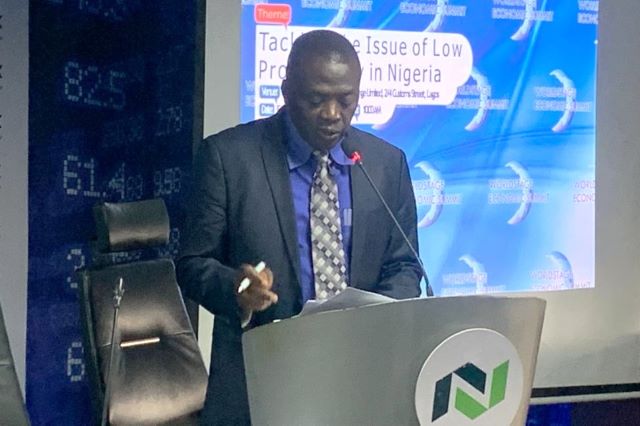
President/CEO of WorldStage Limited, Mr. Segun Adeleye, has called on the Federal Government to consider broader strategic options for addressing Nigeria’s persistent insecurity, including the possibility of joint military exercises with the United States.
Speaking on Friday at the WorldStage Economic Summit (WES) 2025 in Lagos—held under the theme “Tackling the Issue of Low Productivity in Nigeria”—Adeleye noted that insecurity continues to undermine economic activity and investor confidence across the country.
He said international attention on Nigeria’s security challenges is increasing, adding that the government should be open to appropriate partnerships that could help eliminate terrorist groups operating within the country.
Adeleye referenced recent remarks attributed to U.S. President Donald Trump on security-related concerns, suggesting that Nigeria could engage Washington to explore joint operations aimed at neutralising terrorist threats.
“It will be helpful if the Federal Government can ride on the current momentum and adopt the right strategy, including possible foreign assistance, to finally end insecurity,” he said. “If Boko Haram has existed since the administration of former President Olusegun Obasanjo between 1999 and 2007 and still persists today, then it is clear we need additional support.”
The summit drew notable public and private sector leaders, including Mr. Olanipekun Olukoyede, Executive Chairman of the Economic and Financial Crimes Commission (EFCC), and Dr. Olasupo Olusi, Managing Director/CEO of the Bank of Industry (BoI).
Adeleye stressed that Nigeria’s efforts to boost productivity will be futile without addressing the nation’s security challenges. Comparing WES 2025 with the previous year’s summit themed “Nigeria: Setting a Stage for Business and Economic Recovery,” he said indicators show that the economy has recorded signs of recovery, including improved GDP growth, a more stable exchange rate, and rising foreign reserves.
However, he warned that this macroeconomic progress has not translated into meaningful relief for ordinary Nigerians, who continue to grapple with high food inflation, widespread poverty, and a rising cost of living. He highlighted the impact of recent tax reforms introduced in June 2025, the combined pressure of inflation, and currency depreciation, which have eroded household purchasing power.
While the World Bank has expressed cautious optimism about Nigeria’s growth outlook, Adeleye noted that the country’s structural transformation remains slow. The industrial sector’s share of employment has risen only marginally over two decades, while low-quality, informal jobs still account for 92.6% of employment.
He posed a critical question to policymakers: “If the economy is recovering, how do we get it to deliver higher-productivity jobs capable of lifting people out of poverty?”
Adeleye said WES 2025 chose its theme in recognition of the fact that improving productivity is central to reducing poverty, lowering living costs, and ensuring inclusive growth.
The Guest Speaker, Dr. Abidemi C. Adegboye, an economist from the University of Lagos, described Nigeria’s productivity crisis as both “a human tragedy and a defining opportunity.”
For years, WES has served as a platform for generating practical policy recommendations, fostering collaboration between government and business leaders, and stimulating innovative thinking to address Nigeria’s economic challenges.