





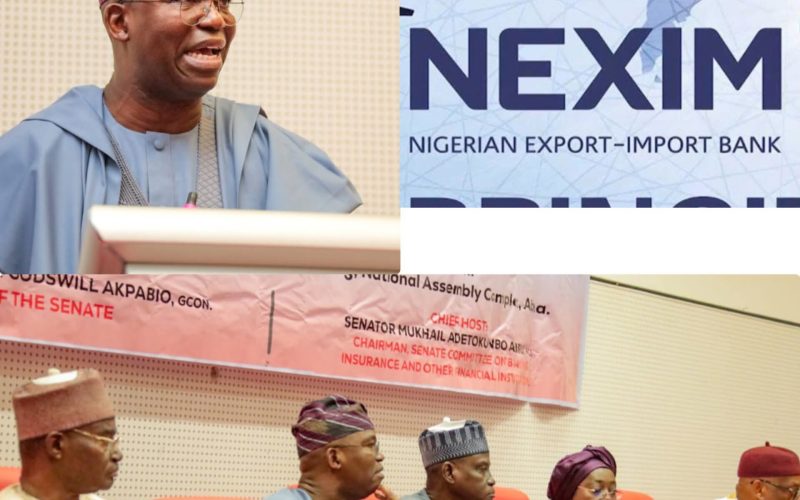
Senate, Stakeholders Endorse ₦1tr Capital Base for NEXIM Bank, Push Reform of Insurance Regulatory Framework
The Nigerian Senate has reiterated its commitment to strengthening the nation’s financial regulatory architecture in a bid to boost economic growth, competitiveness, and institutional efficiency. It has proposed a ₦1 trillion capital base for the Nigerian Export-Import (NEXIM) Bank as part of ongoing reforms to reposition key financial institutions.
The Chairman, Senate Committee on Banking, Insurance and Other Financial Institutions, Senator Mukhail Adetokunbo Abiru, FCA, stated this on Wednesday during a public hearing on two key financial sector bills — the Nigerian Export-Import Bank Act (Amendment) Bill, 2025 (SB. 599) and the National Insurance Commission Act (Repeal) and Insurance Regulatory Commission Bill, 2025 (SB. 394) — held at the National Assembly Complex, Abuja.
Abiru described both bills as “critical to modernizing Nigeria’s financial laws to reflect present realities,” emphasizing that they would strengthen regulatory oversight, promote non-oil exports, and enhance investor confidence.
He explained that the amendment to the NEXIM Act, originally enacted in 1991, seeks to reposition the bank to better support non-oil exports, facilitate trade financing, and empower small and medium enterprises in line with global best practices.
“The existing NEXIM Act was enacted over thirty years ago. Since then, the global and domestic economies have evolved significantly. The law has therefore become outdated and inadequate in addressing modern trade realities, technological advancements, and new financing models that now define the global export landscape,” Abiru noted.
“This amendment seeks to modernize the enabling law to align with contemporary best practices and Nigeria’s strategic economic priorities,” he added.
On the National Insurance Commission Act (Repeal) and Insurance Regulatory Commission Bill, the senator said the legislation would overhaul the insurance regulatory framework, which has remained largely unchanged since 1997. The new bill proposes a stronger, more responsive Insurance Regulatory Commission capable of addressing emerging industry trends such as digital insurance products and fintech innovations.
According to Abiru, both bills align with the Senate’s broader reform agenda aimed at strengthening financial institutions, improving governance standards, and supporting the Federal Government’s drive toward economic diversification and transparency.
“These bills reflect the Senate’s commitment to supporting the executive’s reform agenda, strengthening institutional efficiency, and aligning Nigeria’s financial system with international standards,” he said.
He emphasized that the public hearing provided a platform for constructive engagement among policymakers, regulators, and industry stakeholders to ensure that the final legislation would be both practical and transformative.
Also speaking, the Minister of Trade and Investment, Dr. Jumoke Oduwole, commended the Senate for supporting President Bola Tinubu’s administration in its drive to achieve a $1 trillion economy through strong institutional reforms.
The Commissioner for Insurance and Chief Executive of the National Insurance Commission (NAICOM), Mr. Olusegun Omosehin, lauded the Senate Committee for its leadership in providing a sound regulatory framework that would enable the insurance sector to thrive.
Similarly, the Managing Director and Chief Executive Officer of NEXIM Bank, Mr. Abba Bello, expressed strong support for the proposal to establish an Export Development Fund to boost the bank’s operational capacity. He noted that despite Nigeria’s vast export potential, non-oil exports still account for less than 10 percent of the country’s total foreign exchange earnings, largely due to inadequate export financing.
In closing, Senator Abiru assured stakeholders that all submissions and recommendations from the public hearing would be thoroughly reviewed and reflected in the committee’s report to the Senate.