





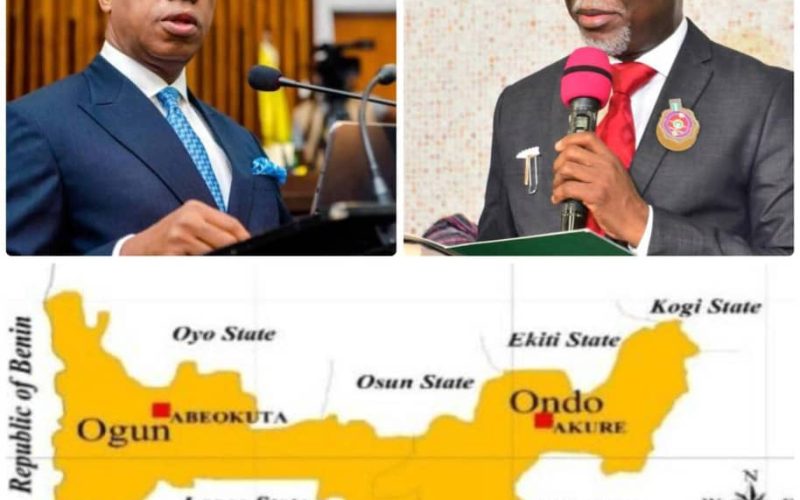
The Ogun State Government has strongly refuted claims by the Ondo State Government over the ownership of Eba Island, insisting that the territory falls squarely within Ogun State and warning against actions capable of triggering communal unrest.
The state government stressed that attempts to drag the long-standing peaceful relationship between the Ijebu and Ilaje peoples into a territorial dispute are unnecessary and dangerous, particularly at a time when an oil well discovered on the island is undergoing investigation.
The dispute followed a statement credited to Mr Allen Sowore, Senior Special Assistant to Ondo State Governor Lucky Aiyedatiwa on Strategic Communication, who claimed that Oke-Agor-Isekun, the location of the abandoned oil well, belongs to Ondo State.
Reacting, the Special Adviser to the Ogun State Governor on Energy, Mr Jide Onakoya, described the claim as misleading and contrary to historical, traditional and legal facts. He said the assertion was disrespectful to the Awujale of Ijebu Land and the Ijebu Traditional Council, adding that credible records clearly establish that Eba Island is within Ogun State’s jurisdiction.
Onakoya explained that official boundary delineations between states and local governments are determined by markers recognised by the National Boundary Commission. According to him, a review of existing maps and boundary documents confirms that Eba Island is located within Ogun Waterside Local Government Area of Ogun State.
Quoting a document from the Palace of Makun-Omi, the state government stated:
“It is indisputable that the oil well currently under investigation is located in Eba Island, which falls within Ogun Waterside in Ogun State.”
The Ogun State Government also faulted Ondo State’s alleged claim over Irokun, a community in Ogun Waterside, describing it as a reckless attempt to incite conflict. It maintained that Irokun has been an Ijebu settlement since the colonial era and has remained part of Ogun State following the creation of states from the former Western Region. It added that geographical boundary declarations along the Bight of Benin clearly place Irokun and Araromi Seaside within Ogun State, noting that the Onirokun of Irokun is a recognised member of the Ijebu Traditional Council.
Tracing the source of the controversy, Ogun State accused Oba Samuel Edema, the Molokun of Atijere in Ondo State, of fuelling the dispute. According to the government, Oba Edema approached the Osobia of Makun-Omi, Oba Kazeem Adesina Salami, in October 2024, seeking permission to undertake a business venture on Eba Island in Ogun Waterside. The request was reportedly declined, after which the matter was formally reported to the Ogun State Government and subsequently referred to the Nigerian National Petroleum Corporation (NNPC) and security agencies.
Following this development, officials of the NNPC and law enforcement agencies reportedly visited the area to carry out due diligence. Ogun State maintained that Ondo State’s response to these lawful actions resulted in a misleading communiqué issued by the Ilaje Traditional Council, which further heightened tensions.
The state government condemned what it described as attempts at territorial expansion and the selective use of outdated colonial documents to support claims that contradict Nigeria’s constitutional framework. It cited Colonial Government Gazette No. 660 of April 29, 1950, which clearly defined the boundary between the Ijebu and Ondo provinces and superseded earlier notices issued in 1919 and 1920. The Gazette, signed by the Acting Chief Secretary to the Colonial Government, H.F. Marshall, was described as definitive on the matter.
Ogun State reaffirmed its commitment to peace and coexistence, urging all stakeholders to respect established legal and historical boundaries in order to avoid unnecessary conflict.