



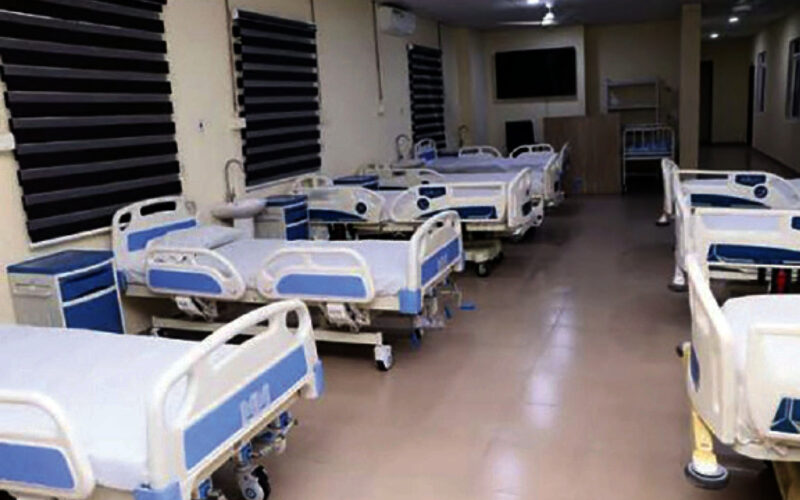
The Lagos State University Teaching Hospital, LASUTH, has become the centre of a heated public debate after announcing a new policy requiring a total upfront payment of ₦430,000 for emergency admissions.
The directive, which hospital management says is necessary to keep critical care running, came at a time when Nigerians are already battling soaring food prices, high transport costs, and stagnant wages. For many Lagosians, the question is no longer about quality of care, but about accessing medical attention when there is an emergency.
According to officials at LASUTH, the decision was driven by years of underfunding, rising operational costs, and the need to stop preventable deaths caused by lack of consumables in the emergency unit.
The hospital also cited the removal of fuel subsidy and inflation as key drivers, noting that a unit of blood has doubled in price, as well as imported medical supplies being affected by forex volatility.
LASUTH management insists the money is not a profit scheme. They say it will be reconciled against actual bills, with refunds issued if the final cost is lower. They also said discussions are on-going with the Lagos State Health Management Agency, (LASHMA), to enrol emergency patients into the state health insurance scheme retroactively.
But for residents who have watched government hospitals deteriorate over the years, government’s explanation makes no sense to them.
Patients who came to the hospital for various health reasons expressed their concerns and rage over the new plan.
Kabir Musa an okada rider, shook his head when he was informed about the policy.
“₦430,000 for emergencies? That’s more than what I make in one year. If my child collapses tonight, where do I get that money from? Government hospitals are supposed to be our last hope. Now even that one is gone. People will die on the road because they can’t afford to enter LASUTH. With this economy, fuel and food already killing us, this policy is like a death sentence for the poor.”
For daily earners, ₦430,000 is not just unaffordable, it is unimaginable.
Ronke Adebayo, a 400-level medical student who does clinical postings at LASUTH, said students and junior doctors have watched the emergency unit struggle for years.
“I understand the anger, but running an emergency unit is extremely expensive. Oxygen, drugs, staff on call 24/7, power, LASUTH spends millions daily. If the government is not funding it properly, the hospital will collapse.
“The ₦430,000 may be to ensure they have cash to treat patients immediately instead of ‘no bed, no drug’ stories. But the government must also create a waiver or insurance system for indigent patients. You can’t charge that amount and leave the poor to die.”
Ronke argued that the real failure is systemic: years of poor budgetary allocation to health, and a health insurance scheme that covers less than 10 per cent of Lagosians.
Grace Ijeoma, a public primary school teacher in Ojo, said the timing could not be worse.
“This is heart-breaking. I earn ₦80,000 a month. If there’s an emergency in my house today, I can’t raise ₦430,000 even if I sell everything. So what happens? We will pray and use herbs? Government should know that sickness is not planned. Instead of adding more burden, they should subsidise healthcare. During hardship like this, the last place government should touch is the hospital bill. It’s wicked.”
Teachers, traders, civil servants, and pensioners say they are the group most affected. Their salaries have not increased with inflation, yet they are not poor enough to qualify for charity and not rich enough to afford private hospitals.
Seyi Ajayi, a visual artist, approached the issue from a human rights perspective.
“This policy is unconstitutional and inhumane. The right to life is guaranteed in the Constitution. You cannot make emergency care conditional on ₦430,000 upfront. What happens to accident victims brought in unconscious?
“Will LASUTH ask for payment first? Government has a duty to provide basic healthcare. If there’s a funding gap, let them be transparent and involve the public. Imposing this during severe economic hardship shows a disconnect from the reality of Lagosians.”
Legal experts have also questioned whether an upfront payment for emergency care violates the National Health Act, which mandates that no hospital shall refuse emergency treatment. LASUTH has not yet responded to that specific legal argument.
Olumide Fasina, an Economist at WestBridge Advisory, Lagos, said the policy reflects a deeper fiscal crisis.
“The government is essentially transferring the cost of healthcare from the state budget to the individual because the state can no longer afford it. With debt servicing consuming over 40 per cent of revenue, and subsidy removal squeezing households, the state is looking for alternative revenue.
“But health is not like fuel; you cannot deregulate it without killing people. What we need is a compulsory, subsidised health insurance pool. Charge ₦430,000, but let 80 per cent of it be covered by insurance so the patient pays ₦20,000 or less. Without that, this policy will increase mortality and out-of-pocket catastrophe.”
Aisha Kadiri, Director of Research at the Centre for Public Policy and Development, added that the timing undermines trust.
“From an economic standpoint, cost recovery in tertiary hospitals makes sense if the system is working. But you cannot introduce cost recovery in the middle of the worst cost-of-living crisis in a generation and expect compliance. People are already skipping meals.
“The elasticity of demand for emergency care is zero, people will not pay. They will die at home. The government must announce immediate waivers for the bottom 40 per cent, and tie this policy to visible improvements. If patients pay ₦430,000 and still buy drugs outside, there will be riots.”
Both experts agreed that Lagos, as Nigeria’s economic hub, must lead in linking hospital funding to the state health insurance scheme, rather than cash deposits.
The Lagos State Commissioner for Health is expected to meet with hospital management and civil society groups soon on the matter. The government is considering a phased implementation and a special fund for indigent emergency cases.
Meanwhile, the Lagos State University Teaching Hospital (LASUTH) has defended its policy requiring unconscious and physically incapacitated patients to have trained caregivers throughout their hospital admission, citing patient safety, dignity and the need for comprehensive care.
The hospital said the policy was designed to provide additional support for patients who, because of their medical conditions, are unable to independently attend to their basic personal and non-clinical needs.
In a clarification issued by its management, LASUTH explained that while doctors and nurses remain responsible for patients’ clinical treatment and nursing care, trained caregivers provide complementary assistance necessary for their comfort and general well-being.
The caregivers are responsible for assisting patients with personal hygiene, feeding where appropriate, movement as permitted by the clinical team, running essential errands and other routine non-clinical needs.
According to the hospital, their presence also ensures that vulnerable patients receive adequate attention and assistance, particularly when family members are unavailable.
Explaining the financial implications of the arrangement, LASUTH said the caregiver service operates on a two-shift system, with each caregiver working for 12 hours.
Under the arrangement, patients are required to pay N10,000 for the day shift and another N10,000 for the night shift, bringing the total daily cost to N20,000.
The hospital further disclosed that a refundable deposit of N200,000 is required to cover the first 10 days of admission.
It added that patients discharged before the expiration of the 10-day period would receive a refund of the unused balance, subject to the hospital’s established refund procedures.
LASUTH said the arrangement was intended to guarantee uninterrupted supportive care for patients who cannot independently meet their basic personal needs.
However, the hospital clarified that engaging caregivers remains optional for patients who are conscious, physically mobile and sufficiently independent to attend to their personal needs.
It said such patients and their families retain the freedom to decide whether or not to engage additional caregiver services.
Acknowledging the financial and emotional burden associated with hospital admission, LASUTH said it remained conscious of the demands placed on patients and their families.
The management, however, maintained that the hospital had a responsibility to introduce measures that protect vulnerable patients and guarantee safe, dignified and comprehensive care.
It urged the public to understand the policy within the context of its commitment to patient-centred healthcare, improved service delivery and internationally recognised patient-safety standards.
The hospital reaffirmed its commitment to providing quality healthcare and ensuring that patients receive the level of attention and support required by their medical conditions.