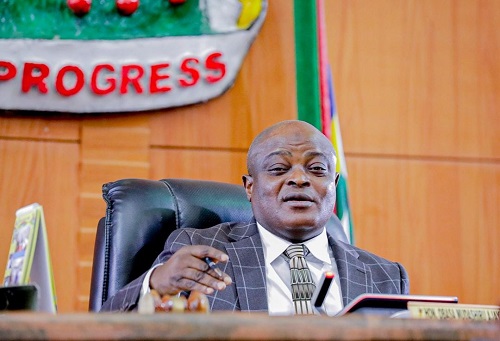






Isa Ali Ibrahim also known as Sheikh Pantami (born 20 October 1972) is the Minister of Communications and Digital Economy in Nigeria. He was the Director General and CEO of the National Information Technology Development Agency (NITDA) of Nigeria from 26 September 2016 – 20 August 2019 when he was nominated as minister and sworn into office on the 21st of August, 2019, as sourced from his Wikipedia page.


EARLY LIFE AND EDUCATION
according to Wikipedia Isa Ali Ibrahim (Pantami) a Fulani, born on 20 October 1972 in Pantami Ward, Gombe State, Nigeria. His mother was Hajiya Amina Umar Aliyu and his father was Alhaji Ali Ibrahim Pantami. He started his education by attending traditional School for memorizing the Qur’an, called “Tsangaya School. He spent more than four years in the school. He later joined primary school in Pantami. He attended Government Science Secondary School in Gombe. After his secondary education, he spent additional two years seeking for more religious knowledge before moving to university. He studied Computer Science at Abubakar Tafawa Balewa University in Bauchi, Nigeria, gaining a BTech in 2003 Session and an MSc in 2008, before obtaining a PhD from Robert Gordon University, Aberdeen, Scotland. He spent his life pursuing both formal and informal education, by switching from one form to another.
He was also trained on Digital transformation at Harvard University, USA, then Management Strategy at both, Massachusetts Institute of Technology, and Institute of Management Development in Loussaune, Switzerland. He was also in Cambridge University for Management Programme, among others.
CAREER
Dr Pantami lectured at Abubakar Tafawa Balewa University in Information Technology before joining the Islamic University of Madinah as Head of Technical Writing in 2014. In 2016, he was appointed as the Director General/CEO of the National Information Technology Development Agency (NITDA). He was confirmed by President Muhammadu Buhari as part of 13 newly appointed chief executives for 13 government agencies. His directive for NITDA upon employment was to develop the ICT infrastructure in the North East in the aftermath of the destruction caused by Boko Haram insurgency. Shortly after the WannaCry ransomware attack, he organized the second annual conference on “Financial Fraud and Cyber Crime” in Abuja with the Federal Ministry of Justice and private sector partners. He also initiated the Nigerian national public key infrastructure (PKI) programme, and went into a security partnership with ESET, an IT security company that offers anti-virus and firewall products.
ACHIEVEMENTS
“Dr Pantami is the first Minister of Communications and Digital Economy after the redesignation of the Ministry’s Name to include responsibilities for creating and formulating Policies for a sustainable Digital Economy for Nigeria. He has hitherto received an award as the “ICT Promoter of the Year 2017” in London by The Nigerian in recognition of “positive contributions to the ICT revolution in Nigeria, youth empowerment & good governance”. Within little less than 3 years of his stewardship, he has received over 110 awards and recognitions both within and outside Nigeria.
Dr Pantami is a fellow of both British Computer Society (FBCS) and Nigeria Computer Society (FNCS). He also has many fellowships to his credit.
RELIGION
Dr Pantami is a Jumu’ah Chief Imam who has been leading the Jumu’ah prayer for over 20 years in both Nigeria and the United Kingdom. He serves as a Member of Shari’ah Board of Jaiz Bank. He is also a Shurah member and Deputy Secretary General of the Supreme Council for Shari’ah (SCS) in Nigeria. He was educated in Islam by scholars including Muhammad Umar Fallatah, Muhammad ibn al Uthaymeen and Abdulmuhsin ibne Abbad. He also is the Chairman of Board of Trustees of Al’Hudah Islamiyyah & Mosque Foundation, and a member/secretary of Bauchi State Elders Advisory Committee and Bauchi state National Qur’anic Competition Committee among other committees.
PUBLICATIONS
Dr Pantami is an author of books on ICT, STEM, technology, politics & community reconciliation, religion and peaceful coexistence, as well as some over 20 publications in international journals, including International Journal of Innovative Research in Engineering and Management (IJIREM), Macrotheme Review, and International Journal of Computer & Information Technology. His Publications and Presentations at various Fora can be accessed from his Profile on Research Gate.
Religious books authored by him include Islam and Politics, Synonimity or Dichotomy?, Month of The Qur’an & Its Virtues, and 63 Steps of Performing an Acceptable Hajji and Its Spiritual and Moral Lesson.
CONTROVERSIES
Alleged conversion
Nigerian Minister of Communications and Digital Economy, Ali Isa Ibrahim Pantami is a man of many descriptions. To some, he is a bright-eyed, relentlessly intelligent and academically competent Young Turk, who has found his way into the topmost level of Nigeria’s government at the relatively young age of 48.
To others, he is a symbol of how deeply held and unapologetically public religious faith can coexist and interoperates with modernity and cosmopolitanism without contradiction.
According a report by Sahara Reporters his Twitter handle proudly displays his impressive academic credentials side-by-side with his proud elementary educational background at an Islamic Tsangaya (non-Hausa readers might be more familiar with the term ‘Almajiri’).

Despite his impressive credentials and his reportedly genial personality which have endeared him to many however, several whispers and rumours about an allegedly dark past have continuously swirled around him at every point in his 5 year-old career as a public servant. From his 2016 appointment as DG/CEO at the National Information Technology Development Agency (NITDA), through to his appointment as a cabinet minister in 2019, these rumours have refused to go away.
Today for the first time ever, we can authoritatively lift the veil on Dr. Ali Isa Ibrahim Pantami and establish his strong and indisputable connections to – and deeply held sympathies for – the dark world of Salafist Islamic terrorism. It is a story that starts in Pantami Ward in Gombe State; meanders through extreme controversy at Abubakar Tafawa Balewa University in Bauchi State; takes a notable detour through a Saudi Arabian university known as a global hotbed for Salafist terror recruitment; and eventually ends with a known terror sympathiser and ideological ‘gradualist’ sitting in Nigeria’s federal cabinet.
Pantami’s Educational Controversies
Variously known as “Dr Isa Pantami,” “Sheikh Ali Ibrahim,” and “Shaykh Isa Ali Pantami” he has the unique distinction of being one of the very few people to achieve very high levels of academic achievement in both Western and Islamic education. Following a non-standard education path that included 4 years at a Tsangaya and 2 years of independent Islamic study after primary and secondary school, Pantami gained admission to the Abubakar Tafawa Balewa University (ATBU) in the late 1990s where he studied Computer Science. He graduated with a BTech in 2003, followed by an Msc in 2008 and this is where the story gets interesting.
His official Twitter handle includes a bio link to his Wikipedia page, which is poorly referenced and light on detail. On further examination of the sources attributed on his Wikipedia page, it becomes evident that much of what is written there was in fact lifted word-for-word from an official government press release sent out to the media.
In June 2017, rumor spread in Nigeria that Pantami has led the conversion of Solomon Dalung, the Minister of Youths and Sports, from Christianity to Islam at the an-Noor Mosque in Abuja. The rumor was denied by both Pantami and Dalung.
Alleged EFCC investigation
There have been allegations that Economic and Financial Crimes Commission (EFCC) was investigating the 2017 spending of NITDA, though Pantami and Adebayo Shittu, the Minister of Communications, claimed that no such investigation happened.
Alleged links to Boko Haram and resurfacing of fundamentalist speeches

In April 2021, a publication by an online media company linked the Pantami to then leader of Boko Haram, Mohammed Yusuf as allies, and that Pantami has been listed by the American Government under its terrorist watch list. Though the publication was later retracted by NewsWireNgr – a third party newspaper that copied the publication from Independent Newspapers Nigeria, no retraction has been published on the website of Independent Newspapers Nigeria although the article was taken down. An independent investigation conducted by Premium Times found some of the claims to be untrue, namely the claim that Pantami was “friendly” in a 2006 debate with Yusuf where Pantami in fact argued with Yusuf in support of Western education and serving under a non-Islamic state, but could not confirm if Pantami was placed on the watchlist by the United States of America as the US government does not disclose those on the list. Pantami threatened to sue the publications that published the original article, stating that while he accepts the retraction from NewsWireNgr, “investigative journalism requires the investigation before publishing, not after” and that “major publishers will meet my lawyers in the court on this defamation of character.
However, audio published by Peoples Gazette shows that Pantami was sympathetic to Boko Haram members when delivering sermons at several worship centers in the mid to late 2000s. This revelation led to further resurfacing of Pantami’s old speeches, including a 2004 speech where he expressed support for the Taliban and al-Qaeda (“Oh God, give victory to the Taliban and to al-Qaeda”) and claimed that “jihad is an obligation for every single believer, especially in Nigeria.” These speeches along with other speeches like one from 2006 where Pantami mourned the death of the leader of Al-Qaeda in Iraq, Abu Musab al-Zarqawi (“May God have mercy on Ahmad Fadeel al-Khalayleh [al-Zarqawi’s birth name]) were included in a 2019 paper Debating Boko Haram that went mainly unreported in Nigeria. The statements ignited controversy and calls for Pantami’s resignation as Communications Minister under the hashtag, #PantamiResign.
Pantami denied condoning terrorism or holding bigoted beliefs, claiming that the majority of his staff are Christians and saying in a Peoples Gazette interview that ‘if I did not like Christians or I did not see them as my brothers and sisters, I would not have been working with them for so long.” He also said that he had “long preached peaceful coexistence amongst people of every faith and ethnicity” along with claiming that the authors of Debating Boko Haram erred in failing to reach out to him and may have used a poor or biased translation of Hausa. A pro-Pantami campaign to counter the online calls for resignation was exposed when the official Ministry of Communications and Digital Economy Twitter account accidentally tweeted #PantamiWillStay and #PantamiwillnotResign on 17 April after two days of #PantamiResign trending; the tweet was quickly deleted. Supporters of Pantami with no clear connection to his Ministry did eventually get the #PantamiWillStay hashtag trending on Twitter; however, due to the Ministry’s accidental tweet, it is unclear if the trend was organic.
Pantami Explanation for His Extremist’s Views as a Young Ustaz
“Some of the comments I made some years ago that are generating controversies now were based on my understanding of religious issues at the time, and I have changed several positions taken in the past based on new evidence and maturity.
“I was young when I made some of the comments; I was in university, some of the comments were made when I was a teenager. I started preaching when I was 13, many scholars and individuals did not understand some of international events and therefore took some positions based on their understanding, some have come to change their positions later.”
Isa Ali Ibrahim also known as Sheikh Pantami (born 20 October 1972) is the Minister of Communications and Digital Economy in Nigeria.
Some social media reactions
Do you think he should keep his job as the Minister of Communications and Digital Economy in Nigeria?