

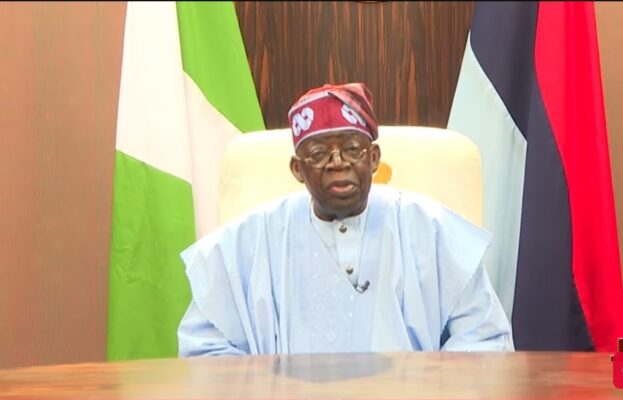
President Bola Ahmed Tinubu has declared that Nigeria has passed through its own “Red Sea” of difficult economic reforms and is now entering a new era of shared and widespread prosperity.
Tinubu made the declaration on Thursday, October 1, 2026, in his Independence Day address to Nigerians as the country marked its 66th Independence Anniversary, with the theme “From Reform to Prosperity.”
The President said Nigeria’s journey since independence had been marked by significant challenges, including civil war, military rule, economic crises, insecurity and political upheaval. Despite these difficulties, he said, the resilience and determination of Nigerians had kept the country moving forward.
According to Tinubu, the difficult economic decisions taken by his administration were necessary to confront long-standing structural weaknesses in the economy.
He likened Nigeria’s economic situation to a patient diagnosed with cancer who must choose between undergoing painful treatment or merely taking medication to suppress the symptoms.
“For too long, Nigeria’s leaders chose morphine while praying for a miracle that never came,” the President said, arguing that previous policies had addressed symptoms rather than the underlying problems.
Tinubu said the reforms introduced by his administration had been difficult and had imposed real hardship, but insisted that the reforms did not create Nigeria’s economic weaknesses; rather, they confronted them.
‘Nigeria’s Economic Outlook Has Improved’
The President said that, three and a half years into his administration, economic indicators showed signs of improvement.
He cited economic growth of more than four per cent in 2026, reduced oil theft, a substantial decline in inflation from its peak, rebuilt foreign reserves and greater stability in the foreign exchange market.
He also said Nigeria recorded more than $6 billion in non-oil export earnings in 2025, describing the figure as evidence of increased activity by Nigerian businesses.
Tinubu maintained that the country had now reached a turning point, with the immediate task of economic stabilisation giving way to a broader focus on prosperity.
“The age of reform has done its work. Now begins the age of prosperity.”
Focus Shifts to Cost of Living, Jobs and Production
The President said the next phase of his administration would focus on reducing the cost of living by lowering the cost of producing and transporting goods.
He listed increased investment in mechanised agriculture, irrigation, improved access to seeds and fertiliser, storage facilities and transportation infrastructure among the government’s priorities.
He said roads, railways and ports would continue to be developed to connect farms and factories with markets, while efforts would also be intensified to reduce energy and logistics costs for businesses.
Tinubu also placed job creation, enterprise and industrial growth at the centre of the next phase of his administration.
He said the government would deploy Nigeria’s gas resources to support new industries, revive manufacturing centres, expand digital connectivity, improve access to skills and provide businesses with infrastructure and financing needed for expansion.
“I want to see more Nigerians making things. I want to see more Nigerian farms feeding our cities and supplying our factories. I want to see Nigerian businesses selling Nigerian goods to the whole world,” he said.
Government Will Continue Support for Vulnerable Nigerians
While declaring that the reform phase had laid the foundation for prosperity, Tinubu acknowledged that millions of Nigerians were still struggling with food, school fees, healthcare costs and transportation.
He said the government would continue strengthening social interventions, including support for vulnerable households and improvements to the National Social Register.
He also highlighted the Nigerian Education Loan Fund, CREDICORP and investments in primary healthcare and basic education as measures designed to support Nigerians while the economy expands.
“These programmes are not substitutes for prosperity. They are a bridge to aid our nation’s citizens on their path towards it,” he said.
The President added that the government’s ultimate objective was not merely to manage poverty but to eliminate its underlying causes through sustained economic growth and the creation of millions of productive opportunities.
‘We Have Passed Through Our Own Red Sea’
Tinubu urged Nigerians to remain focused on the future, saying the country had corrected its economic course and laid what he described as the foundations for lasting prosperity.
He acknowledged that the road ahead would still require discipline, sustained growth and collective effort, but expressed confidence in Nigeria’s potential.
“Nigeria has corrected its course. We have passed through our own Red Sea. This is not the time to look back. Let us go forward together, with faith in ourselves, faith in our country, and faith that the sacrifices we have made will yield their reward,” he said.
The President described the Nigeria ahead as a “Promised Land” of abundance and opportunity, where prosperity would be broadly shared and every child would have the opportunity to dream beyond the circumstances of birth.
“Our destination is in sight. Our foundations are strong. Our direction is clear. So let us go forward. No looking back,” Tinubu declared.
He concluded by wishing Nigerians a happy 66th Independence Anniversary and calling for continued faith in the country and its future.
God bless the Federal Republic of Nigeria.