






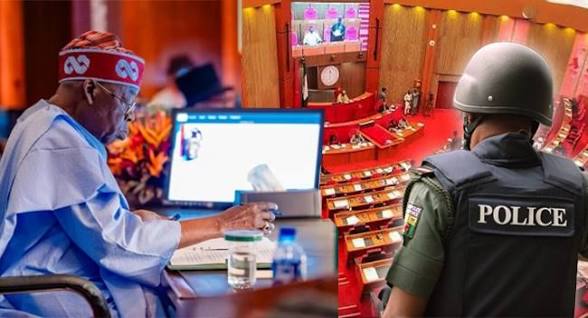
Presidency seeks sustainable funding model as 30 states back decentralised policing; Lagos lawmakers demand clear division of powers
The proposed establishment of state police in Nigeria has gained further momentum, with five additional state Houses of Assembly endorsing the constitutional amendment, bringing the reported number of supporting states to 30.
The development comes as the Presidency urged business leaders to help develop a sustainable funding and implementation framework for state policing, warning that inadequate financing could undermine the reform and expose police institutions to undue private influence.
The Lagos, Kano, Jigawa, Ebonyi and Kogi State Houses of Assembly endorsed the proposed amendment on Tuesday, joining other state legislatures in supporting efforts to decentralise Nigeria’s security architecture and strengthen responses to insecurity.
The Presidency maintained that the success of the proposed reform would depend on states’ financial capacity to pay personnel, provide adequate training and sustain operational activities beyond the initial purchase of vehicles, uniforms and other equipment.
Chief of Staff to President Bola Tinubu and Chairman of the Presidential Working Group on the National Policing Bill, Femi Gbajabiamila, made the appeal on Monday during a plenary session on Security, Stability and Economic Resilience at the 32nd Nigerian Economic Summit in Abuja.
He challenged the Nigerian Economic Summit Group (NESG), chambers of commerce and other business associations to develop practical financing arrangements, institutional management structures and accountable partnerships to support the proposed state police system.
According to him, insecurity continues to impose significant economic costs on businesses through disrupted supply chains, delayed investments and lost commercial opportunities.
Gbajabiamila urged private-sector leaders to engage state governments and legislators as discussions on the reform progress, noting that their expertise in financial management, risk assessment and institutional governance could contribute to a sustainable policing framework.
“I therefore ask the Nigerian Economic Summit Group to carry this engagement beyond our meeting. Bring forward a considered private sector contribution on financing and implementing state police, with practical proposals for accountable partnerships,” he said.
He, however, cautioned that private-sector participation must not compromise police independence or create opportunities for individuals and organisations to influence investigations.
“Public funding must remain dependable, and a donation must never purchase influence over an investigation or preferential treatment,” he added.
Lagos Assembly endorses amendment, seeks clarity on police powers
In Lagos, lawmakers reconvened from their recess to consider the proposed constitutional amendment and unanimously voted in favour of establishing state police.
The Speaker of the Lagos State House of Assembly, Mudashiru Obasa, described the decision as a significant milestone in the long-running legislative effort to reform Nigeria’s policing structure.
He noted that state police had remained a recurring issue across successive assemblies, from the fifth to the 10th Assembly, as lawmakers explored ways to improve security and protect lives and property.
However, Lagos lawmakers called for a clear division of responsibilities between federal and state police authorities to prevent jurisdictional conflicts and ensure effective coordination.
The proposed amendment seeks to establish state police services while retaining the Nigeria Police Force at the federal level.
The National Assembly reportedly gave state legislatures 30 days to communicate their positions on the constitutional alteration, either supporting or opposing the proposal.
The endorsement process follows the transmission of the Constitution of the Federal Republic of Nigeria, 1999 (Sixth Alteration) Act, 2026, by the National Assembly to state legislatures for concurrence.
A two-thirds majority of the 36 state Houses of Assembly is required for the constitutional amendment to secure approval at the state level.
Other states reported to have endorsed the proposal include Adamawa, Kwara, Nasarawa, Ogun, Osun, Enugu, Anambra, Imo, Ekiti, Kebbi, Oyo, Plateau, Taraba, Zamfara, Bayelsa, Benue, Abia, Yobe and Kaduna.
Presidency submits policing bill and 29 amendment bills
Providing an update on the reform process, Gbajabiamila disclosed that the Presidential Working Group had submitted the draft National Policing Bill and 29 consequential amendment bills to the Federal Ministry of Justice for review on October 19, 2026.
He said the proposals would be presented to President Tinubu for approval after the legal review and final consideration by the working group, before being transmitted to the National Assembly.
The proposed framework is designed to enable states with the willingness and financial and institutional capacity to assume greater responsibility for local security, while preserving a strong federal police institution to address interstate crimes and specialised national security threats.
Gbajabiamila argued that decentralised policing could improve local intelligence gathering and response times, addressing what he described as the imbalance under which states were expected to tackle insecurity without having corresponding authority to organise their own police services.
He acknowledged concerns that state police could be abused by political officeholders against opponents or vulnerable communities.
The Presidency, he said, intended to address such risks through enforceable safeguards, national professional standards and independent oversight mechanisms.
“The concern that police powers could be used against political opponents or vulnerable communities is serious. Our answer is to place enforceable limits on those powers and provide remedies when they are abused,” he said.
He further assured Nigerians that the federal police would continue to provide policing services in states that were not yet financially or institutionally prepared to establish their own police services.
The ongoing constitutional and legislative processes are expected to determine the framework for implementing state police, including funding arrangements, accountability mechanisms and the respective responsibilities of federal and state authorities.


