





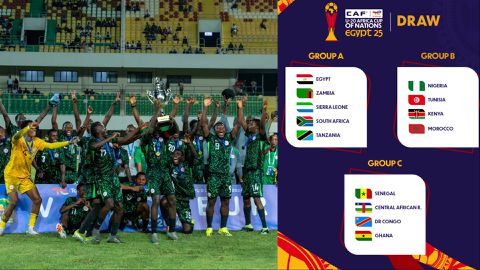
The group phase of the 24th Africa U20 Cup of Nations will feature Nigeria, Morocco, Kenya, and Tunisia, with the competition scheduled to be held in Egypt from 27th April to 18th May this year.
During the redraw ceremony held at the Egypt Football Association headquarters in Cairo on Sunday, Egypt and South Africa, initially placed in Nigeria’s pool prior to Cote d’Ivoire’s withdrawal as tournament hosts, were reassigned to Group A.
Egypt, the new host nation, leads Group A, comprising five teams, including Zambia, Sierra Leone, South Africa, and Tanzania.
Meanwhile, the Flying Eagles will face two North African teams, Tunisia and Morocco, as well as Kenya from East Africa, in pursuit of a quarter-final berth.
Reigning champions Senegal head Group C, competing against the Central African Republic, Democratic Republic of Congo, and Ghana.
After a three-week training camp in Katsina, the seven-time African champions are now back in Abuja, with an expected departure for Egypt this week, where they will undergo an eight-day final-phase preparation ahead of the competition.
The top four semi-finalists from the tournament in Egypt will then represent Africa at the FIFA U20 World Cup in Chile, scheduled from 27th September to 19th October.
GROUP A: Egypt, Zambia, Sierra Leone, South Africa, Tanzania
GROUP B: Nigeria, Tunisia, Kenya, Morocco
GROUP C: Senegal, Central African Republic, DR Congo, Ghana