




Customs, NUPRC, MDAs may cede tax collection to NRS, new VAT sharing formula begins Jan 1, 2026
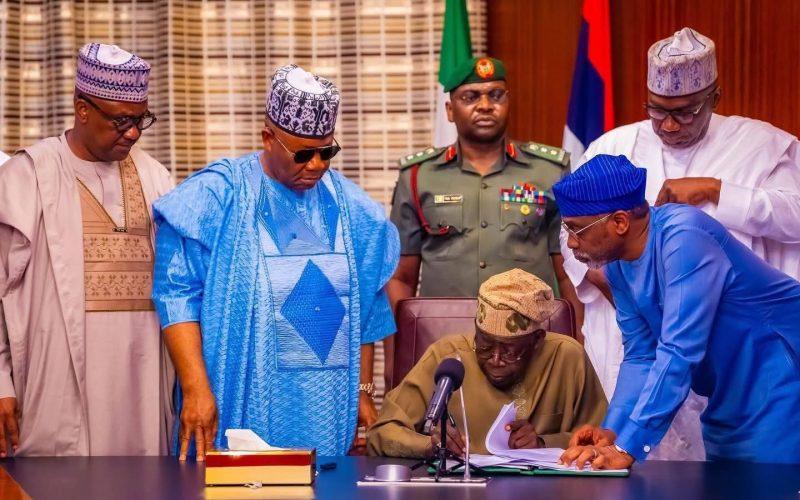
President Bola Tinubu on Thursday signed into law four tax reform bills, declaring that it signals Nigeria’s readiness for modern economic growth and international investment.
Following Tinubu’s assent to four tax reform bills, key revenue-generating agencies, including the Nigeria Customs Service, Nigerian Upstream Petroleum Regulatory Commission, and several federal ministries and agencies, may lose their tax collection mandates.
The development, which establishes the Nigeria Revenue Service as the sole body responsible for collecting federally chargeable taxes, is expected to trigger major restructuring across the federal revenue architecture.
“We have opened the door for new economic and business opportunities. We are showing that Nigeria is truly ready and open for business. Easy in, easy out,” said Tinubu at the signing ceremony held at the State House in Abuja.
The President acknowledged the complexities involved in tax reforms but praised stakeholders for demonstrating leadership and courage through the process.
Commending the collaborative effort behind the legislative process, he added, “What you have provided is leadership and courage in the face of mounting dispute. Nowhere in the world will tax reforms be any easier”.
According to him, the signing marks a turning point in the nation’s fiscal direction: “We are in transit. We have changed the rule. We have changed some of the misgivings. The question of our tax-to-GDP and all other formulas will be obsolete,” he said.
Thursday’s signing comes nearly two years after President Tinubu, on July 7, 2023, approved the establishment of a Presidential Committee on Fiscal Policy and Tax Reforms.
He appointed Mr Taiwo Oyedele, a Fiscal Policy Partner and Africa Tax Leader at PriceWaterhouseCoopers, as committee chairman. It came hours after he signed four Executive Orders, suspending the five per cent excise tax on telecommunication services and the excise duty escalation on locally manufactured vehicles.
The committee, inaugurated on August 8, 2023, comprised experts from both the private and public sectors. It was mandated to retrofit various aspects of tax law reform, fiscal policy design and coordination, harmonisation of taxes, and revenue administration.
On October 24, 2023, Oyedele presented a 30-day quick-wins report to President Tinubu, recommending the merger of over 200 taxes paid by Nigerian businesses into 10. In the months that followed, the committee undertook extensive engagements with stakeholders, culminating in the tax bills presented to the National Assembly in late 2024.
However, the bills faced resistance at the National Assembly and among some state governors, who rejected their passage. The Comptroller-General of the Nigeria Customs Service, Bashir Adeniyi, earlier said that the proposed tax reform bills are in jurisdictional conflict with the NCS and threaten the agency’s existence.
At the NASS, the bills sparked heated debate, particularly around the revenue-sharing structure, which governors from the North opposed. They warned that a shift toward derivation-based allocations, especially with VAT, could tilt fiscal balance in favour of southern states with stronger consumption bases.
After prolonged dialogue, the VAT rate remained at 7.5 per cent, and a new exemption was introduced to shield minimum wage earners from personal income tax. By May 2025, the National Assembly passed the harmonised versions with broad support, driven in part by pressure from economic stakeholders and international observers who welcomed the clarity and efficiency the reforms promised.
The four bills include the Nigeria Tax Bill (Fair Taxation), Nigeria Tax Administration Bill, Nigeria Revenue Service (Establishment) Bill, and the Joint Revenue Board (Establishment) Bill.
According to the President, “They will unify our fragmented tax system, eliminate wasteful duplications, cut red tape, restore investor confidence, and entrench transparency and coordination at every level.”
Tinubu added that the long-standing burden of Nigeria’s tax structure had unfairly weighed down the vulnerable while enabling inefficiency. Tinubu emphasised that the signing marks the beginning of Nigeria’s tax evolution.
Meanwhile, the Executive Chairman of the National Revenue Service (formerly the Federal Inland Revenue Service), Zacch Adedeji, has announced that the newly signed tax reform bills will take effect on January 1, 2026.
Adedeji, who briefed State House correspondents after Tinubu signed the four tax bills into law, said this would give the administration six months for planning, education, and alignment with the fiscal calendar.
He explained, “Based on best practices globally, because when you have this kind of change, it takes time for all the stakeholders, participant operators, and even the regulator to change the system. So with the magnanimity of the National Assembly, Mr. President, the effective date will be January 1, 2026, by the special grace of Almighty God.”
Adedeji stressed the importance of launching the reforms at the start of a new calendar year, saying, “When you have this kind of change, it’s not what you do mid-year. Because if the application of the law is better, you start from the beginning of the year.
“So effective dates, by God’s grace, will be first of January 2026,” he added.
This timeline, the revenue chief explained, allows for adequate sensitisation, planning, and harmonisation with government budgeting frameworks.
For his part, the Chairman of the Presidential Fiscal Policy and Tax Reforms Committee, Taiwo Oyedele, described the newly signed tax laws as “pro-poor,” saying they will ease the burden on low-income earners, small business owners, and everyday Nigerians.
The Chairman of the Senate Committee on Finance, Senator Sani Musa, stated that the newly signed tax reform laws reflect the true aspirations of Nigerians and are the product of broad consultations, especially with stakeholders who initially opposed the reforms.
Addressing journalists at the signing, Musa acknowledged the initial public backlash—particularly from the northern—but said the National Assembly approached the task with balance and diligence.
He added, “With the consultations and the painstaking nature of the legislative processes that we’ve taken, I believe we are bringing out, we brought out bills that seek the aspirations of Nigerians.
“And what are those aspirations, just as has been highlighted by the Chairman of the Presidential Task Force, we consider the less privileged in terms of earnings, and see that we don’t add burdens on them.”
The senator noted that one of the significant breakthroughs of the legislative process was the harmonisation of Nigeria’s fragmented and duplicative tax system.
He said the review also extended to vital sectors such as oil and gas and the Export Processing Zones, ensuring the laws supported industrial growth and competitiveness.
Chairman of the House Committee on Finance, Rt Hon. James Abiodun Faleke, described the passage of the bills as a once “mission impossible” task made successful through national cooperation.
Faleke commended the efforts of lawmakers, governors, and the Nigerian public for what he called a united effort to overhaul the country’s tax regime. He emphasised that the reforms do not introduce new tax burdens but rather expand the efficiency of collection and plug leakages.
The Nigeria Employers’ Consultative Association on Thursday lauded President Bola Tinubu’s assent to four major tax reform bills, describing it as a significant step towards ending over 10 years of crippling multiple taxation on businesses in Nigeria.
Speaking on the sidelines of the 4th Employers Summit in Abuja, NECA’s Director-General, Adewale-Smatt Oyerinde, said the legislation, which harmonises taxes, levies and fees across all levels of government, was a long-awaited relief for the Organised Private Sector.
“Our immediate reaction is ‘uhuru’, we thank God because we have canvassed this for a long time,” Smatt-Oyerinde told journalists. “The challenges of multiplicity of taxes, levies and fees have been a major issue for the Organised Private Sector for over 10 years.”
The NECA boss noted that while the assent marks a major milestone, the true test lies in effective implementation. “The main work is implementation, and it will come with its own challenges that we are not all aware of right now,” he said. “But we’re happy that he has signed it. The reality for organised businesses in the context of harmonised taxes, levies and fees has begun.”
Smatt-Oyerinde stressed that the issue was not only about tax rates but also the chaotic and inefficient method of collection that had long discouraged business growth.
“The efficiency of tax collection has been a recurring concern for every rational stakeholder. That was why we supported the establishment of the Presidential Committee on Fiscal Policy and Tax Reforms, which did a very humane and consultative job with the bill,” he explained.
He added that the bills are interconnected and were designed to stimulate growth across all levels of the economy, from micro, small and medium enterprises to large corporations.
“You don’t grow from the top. You grow by promoting businesses. Some parts of the reform affect MSMEs, others SMEs, big businesses, and individuals. It’s a chain reaction that we believe will catalyse the entire economy,” he added.
NECA President, Dr Ifeanyi Okoye, in his remarks, echoed similar sentiments, stressing that the reforms must not end with legislation but must lead to practical improvements for Nigerian businesses.
“For over six years, NECA has remained committed to promoting a stable, predictable, and enabling policy environment where all businesses, regardless of sector or size, can thrive,” Okoye said.
He challenged the federal government to show commitment to implementing actionable outcomes from the summit, warning against treating the platform as “another talk shop.”
“This must be a catalyst for the policy coherence and reform implementation that businesses, and indeed, the country urgently need,” he said.
Smatt-Oyerinde further disclosed that NECA had worked closely with the Presidential Committee throughout the drafting of the tax bills and would remain actively engaged with the Federal Inland Revenue Service, the lead agency for implementation.
“We are ready to deepen our collaboration with FIRS to ensure that these reforms work in practice, not just on paper,” he said.
Following the signing of four major tax reform bills by President Bola Tinubu on Thursday, the Special Adviser to the President on Energy, Olu Verheijen, has revealed that the new laws have codified four key executive orders aimed at stimulating investment in Nigeria’s oil, gas, and clean energy sectors.
She said the act has already helped unlock over $6 billion in fresh investments into Nigeria’s oil and gas industry.
Reacting in a post on her official X (formerly Twitter) handle shortly after the presidential announcement, Verheijen described the signing as a “historic moment” and a clear demonstration of the administration’s commitment to driving energy sector reforms through long-term policy clarity.
She explained that the act enshrines into law Presidential Directive 40 and three other key executive instruments. Among the codified executive orders are: Presidential Directive 40: A framework for fiscal incentives targeting upstream, midstream gas, and deep offshore oil projects.
“The 2024 VAT Modification Order: This grants value-added tax exemptions for Compressed Natural Gas, Liquefied Petroleum Gas, and other clean energy products.
“The 2025 Upstream Petroleum Cost Efficiency Order: Designed to reduce operational overheads in the upstream oil sector. Other incentive orders focused on energy transition and infrastructure localisation.
“These reforms have already helped unlock over $6bn in new Oil & Gas investments. With their codification, the administration has delivered long-term certainty and regulatory clarity, ensuring these critical incentives are protected from future policy reversals,” Verheijen stated.
She praised the development as a strategic win for the public and private sectors, stressing that the energy industry now has a legal framework that assures investors of continuity regardless of future political changes.