





Till he breathed his last, Prince Bola Ajibola was a first-class lawyer and patriot. Little wonder Nigeria bemoans his loss as an irreparable blow to the legal profession.
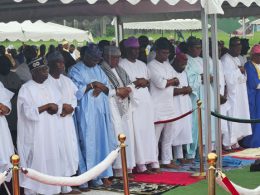
Ajibola died at 85, after a long illness associated with old age, and he has since been buried according to Muslim rites.
Throughout his life, Ajibola inspired many with his significant contributions to nation-building and legal practice. The common impression about him was that he was not only brilliant at law alone but he was also a fair and humane jurist.
He wore the toga of an elder statesman for the common good and sustainable development of South-West and Nigeria as a whole. A cursory look at Ajibola’s intimidating profile reveals a man who did not stumble on stardom but intricately sketched his ascent via diligent, honest endeavour. It was a hard climb, assisted, as all such are, by perseverance.
“Prince” as he was fondly called, was born on March 22, 1934, in Owu, Abeokuta, Ogun State, to the family of Abdul-Salam Ajibola Gbadela II, who was the traditional ruler of Owu between 1949 and 1972
He attended Owu Baptist Day School and Baptist Boys’ High School in Abeokuta between 1942 and 1955. Ajibola obtained his Bachelor’s degree in Law (LLB) at the Holborn College of Law, University of London between 1959 and 1962 and was called to the English Bar at the Lincoln’s Inn in 1962.
Ajibola returned to Nigeria to practise law, specialising in Commercial Law and International Arbitration. He became a Senior Advocate of Nigeria (SAN) in 1980. Due to his pivotal role, the practice of Arbitration and Alternative Dispute Resolution (ADR) became composite parts of Nigerian legal practice.
In 1984, he became the President of the Nigerian Bar Association (NBA) and his performance as NBA president reportedly caught the attention of the then military President, Ibrahim Babangida, who appointed him as the Attorney-General and the Minister of Justice of Nigeria in 1985 to 1991.
Even if Ajibola had not attained the high position of the country’s Attorney-General and the Minister of Justice of Nigeria he would still stand as an important figure in the history of Nigeria.
In his six years in the office, Ajibola was said to never have collected a salary. Vice President Yemi Osinbajo credited some of his professional and personal virtues to the several years he spent understudying Ajibola.
The late Ajibola held numerous international positions and led several Nigerian Delegations to sign many treaties, conventions and protocols; he was equally charged with many international arbitration assignments.
After leaving office in 1991, Ajibola moved to the International Court of Justice (ICJ), Den Hague, Netherlands. After a three-year stint at the World Court in 1994, he served as judge ad hoc of the World Court until 2022. Around that period, he also served as the Nigerian high commissioner to the UK between 1999 and 2002.
Ajibola is best known as Judge of the International Court of Justice, The Hague, Netherlands, 1991 – 94; Judge of the Constitutional Court of the Federation of Bosnia and Herzegovina, 1994 – 2001; President and Judge of the World Bank Administrative Tribunal (Washington D.C and London) 1994-2005; President of the World Association of Judges of the World Jurist Association.
He was appointed judge of the constitutional court of the Federation of Bosnia and Herzegovina and also chairman of the Nigerian delegation to the Nigerian-Cameroon Mixed Commission on the Bakassi Peninsula.
He also became the Vice-President and later President of the World Bank Administrative Tribunal from 1994 to 2005 and he headed the World Association of the World Jurists and Arbitrators, Ethiopia-Eritrea Boundary Dispute Commission.
Ajibola was a walking encyclopedia; he authored different papers and articles on different legal subjects and he also provided legal consultancy services to multinational companies like Avon Cosmetics Limited; Masms Solicitors and Co. of London; Exxon, Houston, Texas, USA and Arthur Anderson and Co., London and Lagos.
His contributions to the education sector have also been significant. Asides from deploying his formidable intellect to progressive educational ventures, he founded the Crescent University, in Abeokuta, Ogun State, in 2005, under the banner of the Islamic Mission for Africa.
Ajibola’s death has been variously described as a great loss not only to Nigeria but to the global society.
He was unarguably one of Nigeria’s finest minds and he would be remembered for his selfless and remarkable contributions to international law, politics, and education.
There is no denying that he lived his principles and departed as an icon of professional integrity and personal probity. When comes another?