


President Bola Tinubu has assured members of the Nigeria Union of Petroleum and Natural Gas Workers (NUPENG) that Nigerians will ultimately enjoy the benefits of his administration’s economic reforms, declaring that the Federal Government is determined to rebuild the economy and deliver a better Nigeria.
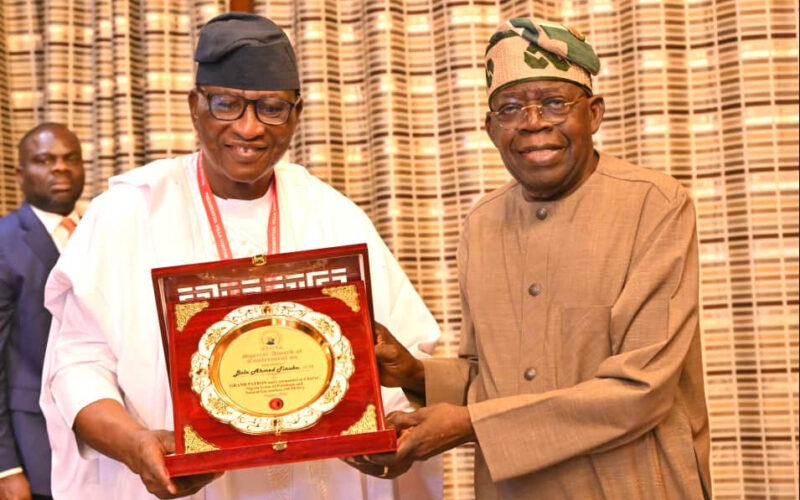
Tinubu gave the assurance on Thursday when the leadership of NUPENG, led by its President, Salimon Oladiti, paid a courtesy visit to him at the Presidential Villa, Abuja.
The President, while commending NUPENG for its cooperation with his administration, said the union occupied a “very critical nerve” of the Nigerian economy and had played an important role in supporting the government’s reform agenda.
He recalled his engagement with the union before assuming office, particularly the meeting at Akodo, Lagos, where he had made his position on fuel subsidy clear despite threats of industrial action.
“You may strike all you want, but fuel subsidy will be gone,” Tinubu recalled telling the workers.
According to him, the decision to remove the subsidy was necessary to prevent the continued distortion of the economy and redirect government resources towards projects capable of delivering long-term value to Nigerians.
He said the Federal Government would soon publish details of how the funds saved from subsidy removal had been been utilised.
The President rejected arguments that the reforms were targeted at ordinary Nigerians, saying the benefits of a restructured economy would ultimately reach workers, families and businesses across the country.
“Who are the people receiving the salaries in the local government administration? Are they not common men and women receiving salary regularly at the state level?” he asked.
“Are they not common men and women? The ordinary people receiving salary at the federal government regularly, and it affects all the market women around us, including your wives.”
Tinubu described the economic reforms as a process of “financial re-engineering and reset”, stressing that the government was laying the foundation for sustainable economic growth.
He thanked NUPENG for its understanding and collaboration, particularly as the government pursues long-term infrastructure projects across the country.
The President listed the Lagos-Ibadan, Abuja-Kaduna and Abuja-Kano roads, as well as the Sokoto-Badagry corridor and other major highway projects, as examples of investments aimed at improving economic activity and the safety of Nigerians.
He also urged petroleum transport operators to ensure that the benefits of the Federal Government’s Compressed Natural Gas (CNG) initiative were passed on to commuters.
“I will appeal to you. We will do more. We will encourage you, but ask your drivers to let it trickle to the commuters too,” Tinubu said.
He expressed concern that the savings and benefits associated with CNG had not been passed down quickly enough to ordinary Nigerians.
“Whatever benefit that is coming from CNG is going into the pocket of truck owners, it’s not spreading as fast as I would like it, but it should spread,” he added.
On the country’s refineries, Tinubu said the government remained committed to restoring them to productive capacity, stressing that the objective was not merely to restart facilities but to make them commercially viable.
“The refineries that you mentioned is going to come back to work,” he said.
“Ordinary flame and smoke of refinery doesn’t mean that it’s working until it is profitable and yields the value for which it is built.”
The President said he had accepted responsibility for both the assets and liabilities inherited from previous administrations and would not dwell on the past.
“I’m not a man who will look back and everything because I’ve accepted the asset and liability of my predecessors, no matter what has happened in the years past,” he said.
“It’s my responsibility now as the President to fix it, make it work for the largest common value of our population. I take responsibility for that, and I’m going to do it.”
Earlier, the NUPENG President, Oladiti, appealed to Tinubu to intervene in the persistent casualisation of workers in Nigeria’s oil and gas industry, particularly in the upstream sector.
Oladiti described the practice as “unhealthy” and said repeated engagements with some oil companies had failed to produce the desired result.
“Your Excellency, our relationship with the International Oil Companies and the indigenous players in the upstream sector has been very cordial. However, we want to seize this opportunity to bring to your attention an unhealthy trend we have been trying to correct with little to no success. It is the casualisation of workers, particularly in the upstream sector,” he said.
He noted that NUPENG and its sister union, the Petroleum and Natural Gas Senior Staff Association of Nigeria (PENGASSAN), had tolerated the practice partly because of the potentially damaging consequences of industrial action in the strategic oil and gas sector.
“For a sector that is strategic and taken as the economic jugular of the nation, NUPENG and its counterpart, PENGASSAN, have been tolerating these unwholesome practices, knowing full well the enormous disruption that any industrial action could cause to the economy,” Oladiti said.
He appealed to the President to use his office to compel affected companies to end the practice.
“We have engaged the management of some of the affected companies without results. Mr. President, we urge you to use your good offices to stop casualisation of workers in our sector,” he said.
The NUPENG leader also commended the Federal Government for the rehabilitation and dualisation of federal highways, saying improved roads would enhance the safety and efficiency of petroleum tanker drivers.
“We’ve seen real progress in the rehabilitation of federal highways, making journeys safer for our tanker drivers,” he said.
He described the ongoing road construction programme as unprecedented, citing the 750-kilometre, six-lane Lagos-Calabar Coastal Highway and the 1,068-kilometre Sokoto-Badagry Superhighway.
“For our members, a good road is the difference between arriving home safely and never arriving at all,” Oladiti said.
“Every stretch of highway rehabilitated or constructed means fewer accidents, fewer spillages, fewer lives lost, and less stress for the men behind the wheel.”
He further commended the administration’s efforts to revive the Warri and Port Harcourt refineries through partnerships with Chinese firms.
However, he urged the President to extend the same intervention to the country’s ageing petroleum depots operated by the Nigerian Pipelines and Storage Company (NPSC).
“Your Excellency, we want to humbly request that the same energy and drive to inject life back to the refineries be extended to the decaying Nigerian Pipelines and Storage Company (NPSC) depots of the country,” he said.
Oladiti recommended that the depots be handed over to private investors under an equity arrangement as part of efforts to restore their functionality.
He also urged Tinubu to promote grassroots development by ensuring that state governments comply with the Supreme Court judgment affirming financial autonomy for local governments.
Responding, Tinubu appealed to Nigerians and organised labour to remain committed to democracy and the reform process, describing democracy as a system built around freedom and opportunity.
“Democracy is about celebration of freedom and opportunity that must be cherished by all of us,” he said.
Acknowledging the difficulties associated with governing a democratic country, the President urged Nigerians to persevere, promising that the reforms would eventually produce tangible benefits.
“It’s not easy to manage a democratic regime full of twists and turns, hills and valleys, and all of that,” Tinubu said.
“But it’s through perseverance, endurance, and good determination that we can bring about… the relief of a newborn baby in a pregnancy.”
He concluded with a promise to Nigerians: “I will promise you, you will enjoy a better Nigeria.”