


Highlights Achievements in Transportation, Security, Healthcare, Infrastructure, Revenue Reforms
… Calls for Stronger Media Partnership
Lagos State Government has reaffirmed its commitment to sustaining the pace of development across all sectors, declaring that the Babajide Sanwo-Olu administration is not slowing down despite approaching the end of its tenure, but remains focused on delivering impactful projects, policies and programmes that improve the lives of residents.
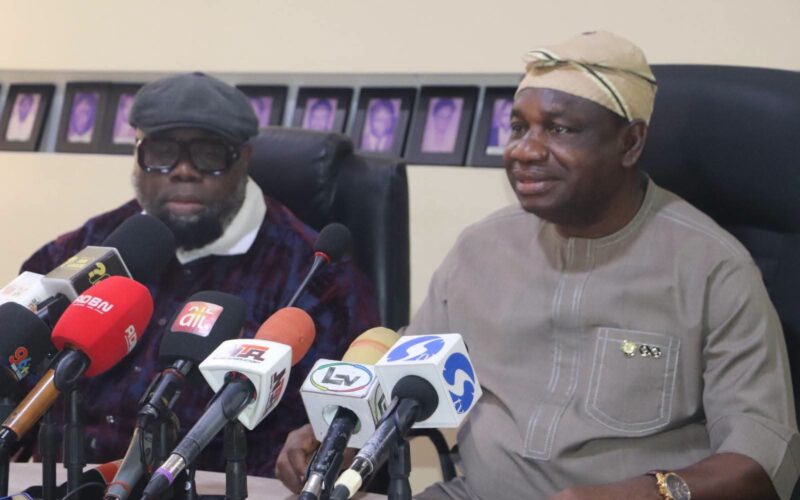
The Commissioner for Information and Strategy, Mr. Gbenga Omotoso, gave the assurance on Friday during a media parley with journalists at the Conference Room of the Ministry of Information and Strategy, Secretariat, Alausa, Ikeja. The interactive session provided an opportunity to showcase the achievements of the present administration, address public concerns, clarify government policies and receive firsthand feedback from media practitioners.
Omotoso, who warmly welcomed journalists to the engagement, said the meeting was conceived to provide a platform for direct interaction between the Ministry and the media, particularly against the perception that governments approaching the end of their tenure tend to become complacent. He maintained that the Sanwo-Olu administration, alongside Deputy Governor, Dr. Kadri Obafemi Hamzat, had sustained its development momentum, citing the recent commissioning of Ijagemo Road in Alimosho and other ongoing interventions as evidence.
“Everybody has seen that, as far as the administration of Mr. Babajide Olusola Sanwo-Olu, the Governor, and his Deputy, Dr. Kadri Obafemi Hamzat, are concerned, there is no slowing down at all,” he stated, inviting journalists to drive the engagement through questions on governance, policies, past achievements, current interventions and plans.
Addressing the impact of infrastructure and transportation investments, the Commissioner highlighted the transformative effect of the Blue and Red Rail Lines on commuting and economic activities, noting that journeys which previously took several hours had been significantly reduced. He disclosed that the Blue Line had recorded approximately nine million passenger journeys and 70,000 trips since commencement of operations, with commuters now travelling between Mile 2 and Marina in about 13 to 15 minutes, compared with the two-and-a-half to three hours previously spent on the route.
He also noted that the Red Line had significantly improved connectivity between Agbado and Oyingbo, reducing travel time to approximately 30 minutes. According to him, the administration’s investments in infrastructure, alongside strengthened security operations, have helped position Lagos as a major financial, entertainment and technology hub in Africa, attracting international events, investments and business opportunities. He stressed that the government’s achievements should be measured not only by physical infrastructure but also by the improved quality of life and the confidence residents have in the city.
On the state’s intermodal transportation agenda, Omotoso disclosed that the government had expanded its waterways fleet from about seven boats at the inception of the administration to at least 32 vessels, while the European Union-supported Omi Eko Project is expected to further unlock the potential of water transportation. He also cited the procurement of 500 last-mile buses, additional high-capacity buses and 24 newly arrived coaches for the Red Line, which are expected to increase operational capacity and passenger movement.
The Commissioner acknowledged the participation of private operators in the transportation sector, given Lagos’ estimated population of between 25 and 30 million, but assured residents that the government would continue to enforce regulations against unroadworthy vehicles. He added that Vehicle Inspection Officers were already removing rickety buses from the roads, stressing that the state remained committed to providing safer and more comfortable transportation options.
Speaking on public safety, particularly recurring fire incidents, Omotoso attributed many outbreaks to human negligence and the improper handling and storage of combustible materials, including petrol. He disclosed that the Lagos State Fire and Rescue Service had intensified public enlightenment campaigns to educate traders and residents on fire prevention, especially during the dry season, urging strict compliance with safety regulations and responsible handling of generators and other fire-related materials.
On flooding and environmental management, the Commissioner maintained that Lagos had a functional drainage network which successive administrations had continued to expand and maintain. While acknowledging the state’s coastal geography and vulnerability to intense rainfall, he identified indiscriminate refuse disposal, construction on drainage channels and encroachment on waterways as major contributors to flooding. Citing the removal of obstructions along a waterway in Ogombo, he urged residents to support government efforts by embracing responsible environmental practices.
Omotoso also addressed concerns about fake news, government statistics and multiple taxation, describing misinformation as a major threat to credible journalism and public understanding of government activities. He insisted that figures released by government officials were verifiable and challenged journalists to uphold professional standards by verifying information before publication. On taxation, he said the harmonisation of levies had reduced multiple collections, citing improvements in Lagos’ ease-of-doing-business ranking from about 26th or 29th position to first place. He added that the Lagos State Government was working with the House of Assembly on further legislative measures to streamline taxes and eliminate arbitrary collections.
Providing insight into the state’s revenue and expenditure, the Commissioner disclosed that Lagos had generated approximately ₦1.7 trillion in revenue, explaining that the resources were being deployed to fund critical infrastructure and social services. He cited the ongoing development of the New Massey Street Children’s Hospital as one of the major investments aimed at expanding healthcare access, noting that the original facility, established in 1914 as a general hospital and converted to a children’s hospital around 1961, had become inadequate for the growing population.
On the relationship between the media and government, Omotoso described Lagos as a strong advocate of press freedom, noting that the state hosts over 72 radio stations and more than 24 television stations operating in an enabling environment. He said the government welcomed constructive criticism, valued journalists as partners in development and remained committed to openness, transparency and timely access to information. He added that the administration would continue to engage the media in promoting informed public discourse and strengthening citizens’ understanding of government policies and programmes.
Earlier, the Permanent Secretary, Ministry of Information and Strategy, Mr. Olatunbosun Ogunbanwo, described the parley as a significant opportunity to showcase the achievements of the Sanwo-Olu administration, address prevailing challenges and engage directly with media practitioners across traditional, social and contemporary platforms.
In his closing remarks, he urged journalists to take responsibility for communicating government policies, projects and programmes, stressing that the administration remained committed to poverty reduction, expanding opportunities and building a secure, functional, safe and productive Lagos. He commended the Commissioner for the insightful engagement and encouraged the media to ensure that residents not only hear about government interventions but also understand, see and experience their impact.