




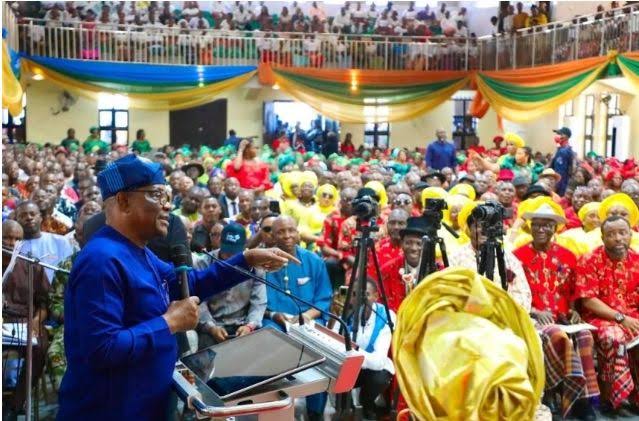
The Lagos State chapter of the All Progressives Congress (APC) has criticised former presidential candidate Peter Obi over his participation in the singing of Nigeria’s old national anthem at a recent town hall meeting organised by the Nigerian Democratic Congress (NDC), describing the incident as a reflection of misplaced political priorities and questionable leadership judgment.
The party argued that the decision to resurrect the old anthem at a political gathering raises concerns about Obi’s understanding of national symbols, institutional conventions and the responsibilities associated with seeking the presidency.
In a statement issued on Saturday, November 14, 2026, the Lagos APC Spokesman, Mogaji (Hon.) Seye Oladejo, described the development as an example of political nostalgia taking precedence over national development and responsible leadership.
According to Oladejo, while Nigerians are entitled to their personal sentiments and historical preferences, national symbols should not be deployed as instruments of partisan political expression, particularly after the country has lawfully adopted a new national anthem.
He noted that although the decision to restore the old anthem could be debated, deliberately using an abandoned national symbol to make a political statement raises questions about the judgment and priorities of those involved.
The Lagos APC spokesman further argued that the episode fits into what he described as a recurring pattern of political gestures and pronouncements that have continued to generate questions about Obi’s appreciation of national institutions, democratic conventions and the diverse aspirations of Nigerians.
He also expressed concern over what he considered Obi’s apparent susceptibility to the sentiments of his immediate political audience, stressing that presidential leadership requires independent judgment, emotional discipline and the ability to provide direction beyond popular sentiments.
“A president must possess the temperament to listen to his supporters without becoming captive to their sentiments. Leadership is not about surrendering personal conviction to the loudest voices in the room or mistaking the applause of an enthusiastic audience for a national consensus,” Oladejo stated.
He maintained that the presidency demands maturity, intellectual discipline, policy consistency and the courage to make decisions in the broader national interest, even when such decisions may not align with the immediate expectations of political supporters.
Oladejo also questioned the consistency of Obi’s political alignments, policy positions and governing philosophy, insisting that Nigerians deserve more than political symbolism, emotional mobilisation and carefully choreographed public appearances.
He said the country’s leadership contest should be centred on clearly articulated, practical and implementable programmes capable of addressing the nation’s economic, security and social challenges.
The APC spokesman further argued that the Nigerian presidency should not be treated as an emotional experiment or an opportunity to indulge the sentiments of an enthusiastic political audience.
He described the old national anthem as a symbol of historical nostalgia for some Nigerians but maintained that its revival at political gatherings cannot replace practical solutions to unemployment, insecurity, infrastructure deficits and the rising cost of living.
According to him, Nigeria needs leaders who can translate national aspirations into measurable development outcomes rather than concentrate on symbolic political gestures.
He also challenged the NDC to demonstrate that it is a credible political platform with a clearly defined vision for national advancement rather than allowing its identity to revolve around symbolic opposition to established national conventions.
“History should inform the future, not hold it hostage. Nigeria needs a leadership culture that prioritises national cohesion, institutional integrity, sound judgment and practical solutions over emotional grandstanding,” he said.
Oladejo reaffirmed the Lagos APC’s commitment to a forward-looking Nigeria, stressing that the country’s development aspirations must not be held back by sentimental attachments to the past or political theatrics presented as patriotism.
He added that while Obi and his supporters were entitled to their preference for the old national anthem, the volume of their singing should not be mistaken for the depth of their patriotism or the strength of their political argument.
The Lagos APC spokesman concluded by expressing confidence that Nigerians would make the right choice in determining the country’s political future, insisting that the destiny of more than 200 million citizens was too important to be entrusted to sentiment, political theatrics and an uncertain leadership philosophy.