

Hon. Faleke, The Workaholic Campaign Architect: Building Today For Tomorrow’s Battle By Musa Asiru Bakare
Political Analyst | Writes from Lokoja, Kogi State
Some politicians campaign to win elections; others use elections to build the political structures that shape the future. Rt. Hon. James Abiodun Faleke’s intensive engagement across Osun ahead of the August 15, 2026 governorship election reflects the latter approach.
Faleke’s intervention goes beyond supporting the All Progressives Congress (APC) candidate, Alhaji Bola Oyebamiji. His activities have focused on reconnecting political actors, rebuilding relationships, strengthening grassroots structures and laying a foundation for the larger political contest ahead, particularly the 2027 elections.
As the National Secretary of the highly successful APC 2023 Presidential Campaign Council, Faleke has once again demonstrated a political style built around organisation, engagement and grassroots mobilisation rather than mere rhetoric.
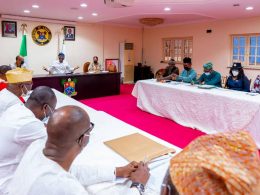
Across Osun, he has engaged party leaders, political elders, traditional rulers, religious leaders, Asiwaju supporters, youths, artisans, market women, ethnic communities, former political office holders and ordinary citizens.
The strategy is deliberate. While every voter may not be a political heavyweight, every voter possesses the ultimate democratic currency—the ballot. Consequently, effective political mobilisation requires more than rallies and speeches; it requires listening, relationship-building and organisation.
The 2023 presidential election in Osun underlined the APC’s considerable strength in the state. President Bola Ahmed Tinubu polled 343,945 votes, while Atiku Abubakar secured 354,366 votes—a margin of 10,421 votes.
Rather than seeing that result simply as an opposition victory, it can also be interpreted as a warning and an opportunity. Political strength must be translated into organised electoral strength, and that kind of structure cannot be created overnight.
Faleke appears to understand that political influence exists across different layers of society. Party elders provide experience and institutional knowledge; traditional rulers offer community influence; youths provide energy; artisans and market women provide grassroots networks; support groups provide organisational reach, while ordinary citizens ultimately determine electoral outcomes through their votes.
When these elements are properly coordinated, they can form a formidable political ecosystem.
His reported engagement has also extended beyond the conventional APC establishment, including interactions with former Ekiti State Governor Ayo Fayose and leaders of the Accord Party. Such engagements point to the broader importance of coalition-building in modern politics, where finding areas of common interest can sometimes be more valuable than emphasising historical differences.
Faleke’s political approach, which is closely associated with President Bola Ahmed Tinubu’s tradition of grassroots mobilisation, coalition-building and strategic organisation, is also evident in his efforts to coordinate Asiwaju supporters and strengthen the wider political family.
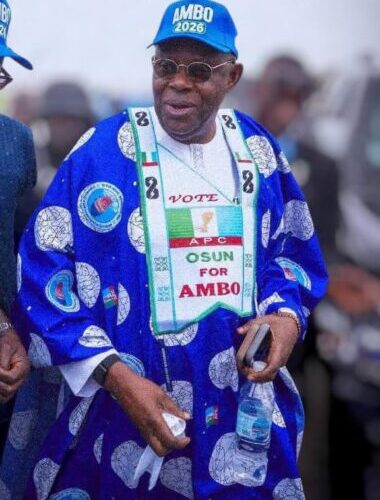
His walk through Osogbo in support of Oyebamiji equally carried a symbolic message: political leadership cannot be confined to meeting rooms and strategy sessions. Leaders must take their message directly to the people, engaging them where they live, work and vote.
There is, however, a deeper lesson in the exercise. Political influence is not an inheritance; it is a responsibility. The strategic politician does not ask only what an election can deliver today, but also what structures, relationships and goodwill will remain after the election.
That is the difference between political consumption and political investment.
Yet, political maturity also demands realism. Meetings, photographs, endorsements and public appearances do not, by themselves, win elections. Votes do.
The ultimate test of Faleke’s intervention will therefore be whether it produces stronger coordination, deeper grassroots mobilisation, increased voter support and, ultimately, victory for the APC candidate.
More significantly, his engagement with political actors and networks with an eye on the 2027 presidential contest suggests that his political calculations extend beyond Osun’s August 15 election.
The machinery for 2027 cannot be assembled in 2027. It must be built now.
In Osun, Faleke is therefore not merely campaigning. He is connecting, organising, strengthening relationships and helping to expand the political network around the APC.
A structure without relationships can become bureaucratic. Relationships without structure can become mere sentiment. But when relationships and organisation converge, political influence can be transformed into electoral power.
That appears to be the essence of Faleke’s method: converting goodwill into organisation, organisation into mobilisation and mobilisation into electoral strength.
Osun 2026 is consequently more than a contest for August 15. It is also a test of whether political relationships can be converted into sustainable electoral strength and whether the lessons of 2023 can inform a more effective strategy for 2027.
Hon. Faleke understands the assignment.
Elections are ultimately won at the ballot box, but the political groundwork for victory is laid long before voters enter the polling booth.