



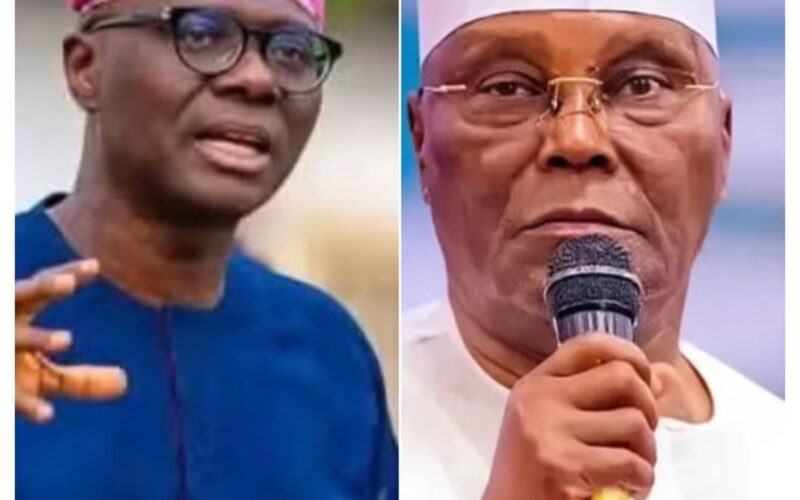
2027: Sanwo-Olu Knocks Subsidy Campaigners, Says Promise to Restore Fuel Subsidy Is ‘Empty Buzz’

Lagos Governor Babajide Sanwo-Olu has fired a warning shot ahead of the 2027 elections, dismissing opposition promises to restore fuel subsidy as “empty campaign buzz” that Nigeria’s finances simply cannot sustain.

Lagos Governor Babajide Sanwo-Olu has fired a warning shot ahead of the 2027 elections, dismissing opposition promises to restore fuel subsidy as “empty campaign buzz” that Nigeria’s finances simply cannot sustain.

Speaking at the 7th Freedom Online Newspaper Lecture in Ikeja, Sanwo-Olu said the subsidy regime had become a drain on national resources, insisting that its removal, though painful, was necessary to redirect funds towards development.

He challenged politicians campaigning on a promise to bring subsidy back to explain how the country would finance such a commitment.

The Governor also defended President Bola Ahmed Tinubu’s economic reforms, citing improved government revenues, economic growth, foreign reserves, remittances and other indicators as evidence that the reforms were beginning to deliver results.

On democracy, Sanwo-Olu declared that Nigeria had travelled a considerable distance since 1999, particularly in electoral reforms and technology, but warned that the country must not become complacent ahead of the 2027 elections.

He further identified youth unemployment and poverty as major drivers of insecurity, highlighting Federal Government interventions in education, credit, technical training, employment and entrepreneurship.

With the 2027 political season already gathering momentum, the Governor’s central message was clear: politicians can promise subsidy restoration, but the mathematics of Nigeria’s treasury must ultimately decide what is possible.

Total
0
Shares
Related Posts
Read More

Big trouble looms for randy lecturers as Senate takes bold step

Under the new law, offenders found guilty of offences outlined in Clauses 4 (1), (2), and (3) face a jail term of not less than five years and up to fourteen years, without an option of a fine. Lesser offences specified under Clauses 4 (4), (5), and (6) attract imprisonment of between two and five years, also without the possibility of a fine. The bill also empowers victims to pursue civil action for breach of fiduciary duty, using the same standard of proof as in civil proceedings. It lists several prohibited acts, including demanding sexual favours, making unwelcome advances, engaging in unwanted physical contact, or inducing others to commit harassment. During deliberations, Senator Adams Oshiomhole (Edo North) urged lawmakers to consider expanding the bill’s coverage to include the workplace and other professional settings, arguing that sexual harassment is not confined to educational institutions. “There is no reason to restrict this legislation to students alone,” Oshiomhole said. “We should design a law with broader application that protects every Nigerian from harassment.” However, Deputy Senate President, Senator Jibrin Barau, who presided over the session, clarified that the bill, already passed by the House of Representatives, was limited to concurrence and that existing statutes already address sexual harassment in workplace contexts. Following the debate, the Senate unanimously adopted and passed the bill for third reading, marking a major victory for advocates of students’ rights and gender protection in Nigeria’s education system.