

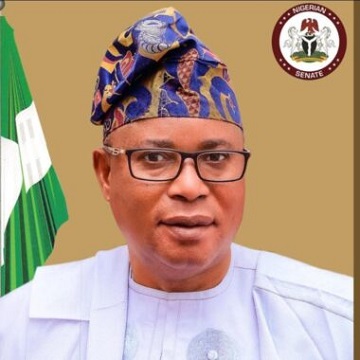
From grassroots administration to legislative leadership and national representation, Senator Wasiu Sanni Esinlokun’s political journey reflects a steady progression of responsibility, experience and public service.
Political careers are often measured by the offices individuals occupy. But for some public figures, the more revealing measure is the breadth of experience accumulated along the way—and how that experience is deployed in subsequent responsibilities.
The public career of Senator Wasiu Sanni Esinlokun falls within that broader narrative of progressive public service.
From grassroots administration as a two-term Local Government Chairman, to legislative leadership in the Lagos State House of Assembly, where he served as Deputy Speaker, and subsequently to the National Assembly as Senator representing Lagos Central Senatorial District, Esinlokun has traversed several important layers of governance.
The offices have changed and the scope of responsibility has expanded, but one thread runs through the journey: an emphasis on representation, institutional responsibility and service.
FROM THE GRASSROOTS: WHERE GOVERNANCE BEGINS
Esinlokun’s understanding of governance was shaped long before his arrival at the National Assembly.
His political and public-service career included grassroots administration in Lagos, where he served as Chairman of Lagos Island Local Government for two terms.
That experience provided a direct understanding of the challenges of local governance—community infrastructure, sanitation, education, social services, local economic activity and the everyday interaction between citizens and government.
Local government remains the level at which many citizens encounter public administration most directly.
For Esinlokun, therefore, governance was not simply a theoretical exercise. It involved direct executive responsibility for a local government and its people.
That grassroots experience would later become an important part of his legislative journey.
FROM EXECUTIVE ADMINISTRATION TO LEGISLATIVE LEADERSHIP
Esinlokun subsequently moved into the Lagos State House of Assembly, where he represented Lagos Island and eventually rose to the position of Deputy Speaker.
In June 2015, he emerged as Deputy Speaker of the 8th Lagos State House of Assembly. Contemporary reports identified him as one of the principal officers of the Assembly.
His legislative career placed him at the intersection of lawmaking, representation, oversight and institutional leadership.
The transition from local government administration to the legislature also meant moving from direct executive management into a system where policy, legislation, representation and oversight are central responsibilities.
That combination of experiences is significant.
An administrator understands the practical demands of implementing government programmes. A legislator must understand how laws and policies are developed, scrutinised and subjected to oversight.
Esinlokun experienced both sides.
THE DEPUTY SPEAKERSHIP: EIGHT YEARS OF LEGISLATIVE EXPERIENCE
As Deputy Speaker, Esinlokun occupied one of the principal leadership positions in the Lagos State House of Assembly.
The position required more than presiding over legislative proceedings. It involved navigating legislative procedures, political relationships, stakeholder engagement and the institutional responsibilities of the House.
His period in the Assembly also coincided with important debates concerning constituency development, legislative autonomy and public engagement.
His profile at the time reflected a politician who had developed considerable familiarity with the machinery of the Lagos legislature. Reports from the period consistently identified him as Deputy Speaker and a senior figure within the Assembly.
The experience would eventually provide a foundation for his transition to national legislative politics.
FROM ALAUSA TO THE NATIONAL ASSEMBLY
In 2023, Esinlokun moved from the Lagos State House of Assembly to the National Assembly as Senator representing Lagos Central Senatorial District.
The move represented another stage in a political career that had already taken him through grassroots administration and state legislative leadership.
By then, his experience included:
Grassroots political organisation;
Executive administration at local-government level;
State legislative representation;
Legislative leadership as Deputy Speaker; and
Extensive engagement with Lagos political and governance structures.
The Senate consequently became the broadest institutional platform yet for deploying that accumulated experience.
REPRESENTATION THAT CONNECTS WITH THE PEOPLE
For a legislator, representation extends beyond participation in plenary debates.
It also involves constituency engagement and interventions that address practical needs.
Under Esinlokun’s current representation, his office has reported interventions in areas including education, skills acquisition, entrepreneurship and healthcare.
Among the reported initiatives is a 2026 scholarship programme for tertiary students from Lagos Central, alongside entrepreneurship training and empowerment programmes.
His office has also reported the facilitation of an ultra-modern X-ray machine for General Hospital, Lagos, in collaboration with the Nigerian Ports Authority.
Such interventions reflect one dimension of modern constituency representation: connecting legislative office with programmes that have direct relevance to citizens.
Education creates opportunity. Skills acquisition can strengthen livelihoods. Healthcare infrastructure addresses immediate community needs.
The value of constituency representation is therefore ultimately measured by what citizens can experience beyond the political rhetoric surrounding an office.
MARINE TRANSPORT AND THE BLUE ECONOMY
At the national level, Esinlokun’s responsibilities extend into an area of particular significance to Lagos and Nigeria’s economic future.
As Chairman of the Senate Committee on Marine Transport, he operates within a sector that encompasses ports, shipping, waterways, logistics and the wider maritime economy.
For Lagos Central, maritime policy is not an abstract national issue.
Lagos is a major commercial and maritime centre, making the efficiency of ports, waterways, marine transportation and related infrastructure directly relevant to commerce, employment, investment and economic activity.
Esinlokun has also participated in discussions on the future of Nigeria’s marine and blue economy, including questions around institutional responsibilities and the legal framework governing the sector.
His Lagos background gives this responsibility an additional dimension: many of the national maritime questions being considered at the Senate level have direct consequences for Lagos communities.
OVERSIGHT AS A CORE LEGISLATIVE RESPONSIBILITY
Another important component of senatorial responsibility is oversight.
The National Assembly’s constitutional role includes scrutinising the activities of Ministries, Departments and Agencies and ensuring accountability in the implementation of government policies and programmes.
Esinlokun has participated in oversight engagements with agencies within the maritime sector, including the Nigerian Shippers’ Council.
Such engagements demonstrate that legislative work extends beyond the passage of bills.
Oversight is part of the constitutional mechanism through which public institutions are examined, questioned and held accountable for the performance of their statutory responsibilities.
A CAREER THAT HAS CONTINUED TO EXPAND
Beyond the formal responsibilities of elective office, Esinlokun’s political experience has continued to attract wider assignments within Lagos and national political structures.
His career has evolved from grassroots politics to local government administration, state legislative leadership and national representation.
Each stage has expanded both his responsibilities and the constituency he is expected to serve.
The progression can be summarised simply:
Grassroots Politics → Local Government Chairman → State Legislator → Deputy Speaker → Senator.
Each position brought a different institutional responsibility.
Each demanded a different level of political and administrative experience.
And each provided another platform for public service.
THE PHILOSOPHY OF STEWARDSHIP
The story of Senator Wasiu Sanni Esinlokun is perhaps best understood through three words:
Passion. Impact. Excellence.
Passion provides the drive to remain engaged with public service.
Impact provides the measure of what public office produces for the people.
Excellence represents the standard expected as responsibility increases.
Public office, after all, is temporary. Its consequences can be much more enduring.
A legislative reform can outlive the legislator who championed it.
A scholarship can alter the future of a young person.
A healthcare intervention can benefit an entire community.
An empowerment programme can strengthen a household’s economic prospects.
And a policy decision can influence an entire sector.
That is why stewardship matters.
A JOURNEY STILL IN PROGRESS
Senator Wasiu Sanni Esinlokun’s journey from grassroots politics and local government administration to the Lagos State House of Assembly and ultimately the National Assembly represents a gradual accumulation of political, administrative and legislative experience.
It is a story of increasing responsibility—from serving communities at the local level to participating in state legislative leadership and now contributing to national lawmaking and oversight.
His political journey is therefore not simply about the offices he has occupied.
It is about the experience gathered in each office, the responsibilities attached to each mandate and the impact expected from every new chapter.
Passion has provided the drive.
Experience has provided the foundation.
Impact remains the measure.
And excellence remains the standard.