



When Moral Authority Begins to Echo Political Opposition
By Seye Oladejo, Lagos APC Chieftain
In every thriving democracy, the voices of religious leaders occupy a special place. They serve as the nation’s moral conscience, reminding those in power of their obligations to justice, compassion, accountability and the common good. Nigeria has been blessed with distinguished clerics whose interventions have enriched public discourse and strengthened democratic values.
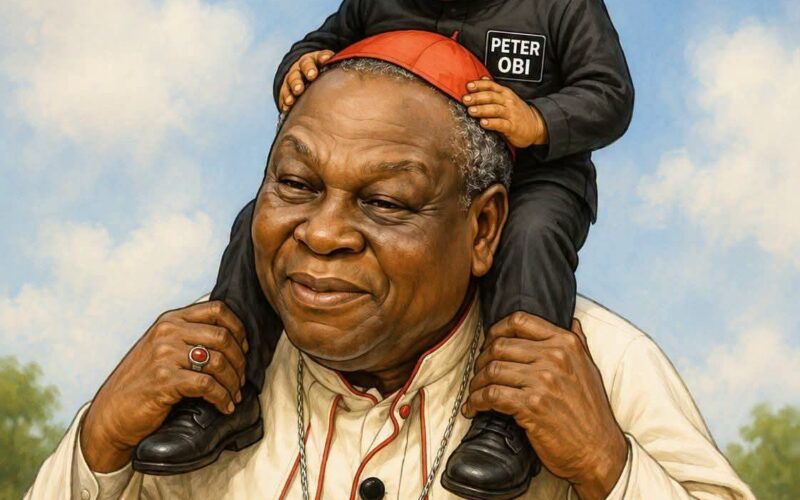
Among them is Bishop John Onaiyekan, a respected statesman whose decades of spiritual leadership have earned admiration across religious, political and ideological divides.
It is precisely because of that stature that his recent comments on the administration of President Bola Ahmed Tinubu deserve thoughtful examination.
The issue is not whether Bishop Onaiyekan has the constitutional or moral right to criticise government. He undoubtedly does. Democracy flourishes when respected voices hold leaders accountable. The more pertinent question, however, is whether his recent interventions still reflect the detached moral authority expected of a revered national figure or whether they increasingly echo the language, priorities and conclusions of partisan political opposition.
The resemblance is becoming difficult to ignore.
The biblical account of Jacob and Esau offers a fitting analogy. Before Isaac bestowed his blessing, he remarked, “The voice is Jacob’s voice, but the hands are the hands of Esau.” Today, Nigerians hear the unmistakable voice of a respected cleric, yet the political fingerprints increasingly resemble those of an opposition that has struggled to secure electoral legitimacy and now appears eager to amplify its message through influential non-partisan figures.
Every government deserves scrutiny, and the Tinubu administration is no exception. However, such scrutiny must be balanced, consistent and grounded in the realities confronting the nation.
Nigeria’s economic challenges did not begin in May 2023.
President Tinubu inherited an economy burdened by decades of structural distortions, unsustainable fuel subsidies, multiple exchange-rate regimes, crippling debt-service obligations, declining oil revenues, widespread insecurity, infrastructure deficits and years of postponed reforms. These were not political talking points but longstanding national realities awaiting decisive leadership.
Faced with those challenges, the President chose reform over political convenience. He embraced difficult but necessary decisions instead of postponing inevitable adjustments for short-term popularity. Predictably, those reforms brought immediate hardship. Equally predictably, political opponents have sought to convert that hardship into electoral capital.
Yet there is another side to the story that objective observers cannot ignore.
State governments now receive significantly higher allocations from the Federation Account, strengthening their capacity to deliver development. Investments in transportation, healthcare, agriculture and education continue to expand. Comprehensive tax reforms are broadening the nation’s revenue base, security operations have intensified across troubled regions, and foreign investor confidence is gradually improving. Inflation has begun to ease from previous peaks, while several macroeconomic indicators point towards increasing economic stability following an unavoidable adjustment period.
These developments do not suggest that the administration has completed its task. Rather, they indicate that difficult reforms are beginning to lay the foundation for long-term national recovery.
Unfortunately, many critics choose to overlook these positive indicators.
Every economic challenge is portrayed as evidence of failure, while every sign of progress is dismissed as insignificant. Such selective analysis moves beyond objective criticism and increasingly resembles political advocacy clothed in moral commentary.
There is also an evident inconsistency in Nigeria’s public discourse.
Many of those who now vigorously condemn every policy of the Tinubu administration maintained a far more restrained posture when previous governments presided over escalating insecurity, massive subsidy fraud, moribund refineries, exchange-rate distortions and mounting fiscal irresponsibility.
True moral consistency requires the courage to speak truth to power irrespective of who occupies Aso Rock.
Religious leaders occupy a unique position in society because they are expected to rise above partisan interests. Their voices should unite rather than divide, illuminate rather than inflame, and challenge authority without appearing to align with political agendas.
This responsibility becomes even more significant at a time when opposition parties remain fragmented, ideologically unsettled and eager for narratives capable of undermining public confidence in the government. Every statement by respected national figures inevitably carries political consequences.
That reality demands an even greater commitment to fairness and balance.
No reasonable supporter of President Tinubu denies the hardship Nigerians currently face. The President himself has repeatedly acknowledged the sacrifices citizens are making and appealed for patience. Responsible leadership is not defined by denying present difficulties but by confronting their underlying causes instead of offering temporary political comfort.
History rarely celebrates leaders who avoided difficult decisions. More often, it honours those who confronted painful realities with courage and vision.
The Renewed Hope Agenda should therefore be assessed not solely by the temporary discomfort accompanying reform but by its long-term capacity to rebuild an economy that had become structurally unsustainable.
Constructive criticism remains indispensable to democratic governance. However, criticism detached from context risks becoming an instrument of political contest rather than an expression of national patriotism.
Bishop Onaiyekan’s influence remains profound, and his voice continues to command respect across the country. That influence should encourage thoughtful national reflection rather than inadvertently reinforce partisan narratives.
Nigeria undoubtedly needs prophetic voices.
But it also needs balanced voices.
There is an important distinction.
When criticism consistently amplifies only one side of the national conversation while overlooking broader realities, an unavoidable question arises: Is this still the independent voice of a revered cleric, or has it become another echo within the increasingly crowded chamber of opposition politics?
That is the question many Nigerians believe Bishop Onaiyekan’s latest intervention has raised.
Until future interventions demonstrate greater balance and consistency, many will continue to conclude that while the voice may indeed be Jacob’s, the hands increasingly appear to belong to Esau.


