



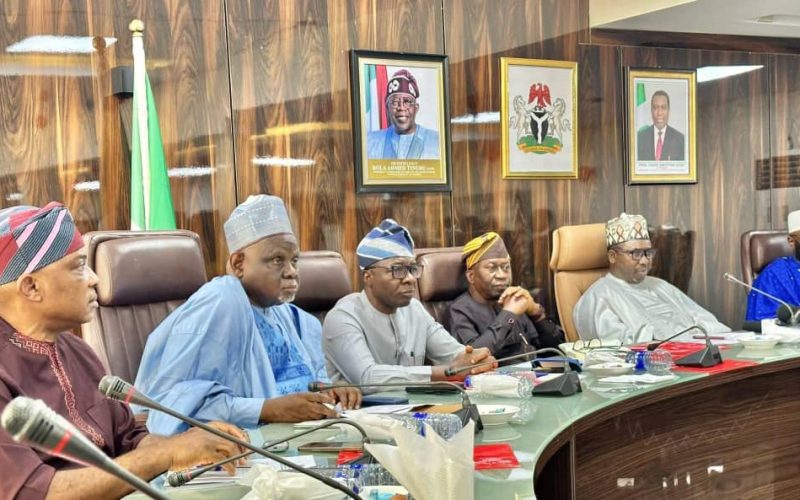
The Independent National Electoral Commission (INEC) has reaffirmed its commitment to delivering credible, transparent and inclusive elections as it engaged leaders of political parties in its first-quarter 2026 stakeholders’ consultation held in Abuja on Thursday.
Speaking at the meeting, INEC Chairman, Professor Joash O. Amupitan, SAN, described the engagement as a significant milestone, marking his first formal consultative dialogue with political parties since assuming office. He noted that the meeting followed earlier consultations with civil society organisations and the media, underscoring the Commission’s resolve to deepen collaboration ahead of a busy electoral cycle.
A key focus of the engagement was the Federal Capital Territory (FCT) Area Council elections scheduled for Saturday, 21 February 2026. INEC disclosed that 1,680,315 registered voters are expected to vote across 2,822 polling units in the six Area Councils—Abaji, Abuja Municipal Area Council (AMAC), Bwari, Gwagwalada, Kuje and Kwali.
According to the Commission, 570 candidates will contest chairmanship, vice-chairmanship and councillorship positions across 68 constituencies. Professor Amupitan revealed that 10 of the 13 activities outlined in the election timetable have been concluded, with political campaigns set to end on Thursday, 19 February 2026.
He assured stakeholders of INEC’s preparedness, stating that non-sensitive materials have been deployed, electoral officials trained, and Bimodal Voter Accreditation System (BVAS) devices configured for voter accreditation and real-time transmission of results to the INEC Result Viewing (IReV) portal. A mock accreditation exercise has been scheduled for Saturday, 7 February 2026, in 289 selected polling units across the FCT.
INEC also confirmed the accreditation of 83 domestic observer groups, five foreign observer missions, and several media organisations to monitor the elections.
Beyond the FCT polls, the Commission announced that bye-elections will also be conducted on 21 February 2026 in Rivers State (Ahoada East II and Khana II constituencies) and Kano State (Kano Municipal and Ungogo constituencies). Attention is further shifting to the Ekiti State governorship election slated for 20 June 2026 and the Osun State governorship election fixed for 8 August 2026.
Looking ahead to the 2027 General Elections, Professor Amupitan disclosed that INEC has finalised the timetable and schedule of activities in accordance with the Constitution and the Electoral Act, 2022. He urged the National Assembly to expedite amendments to the electoral legal framework to ensure certainty and stability ahead of the polls.
On voter participation, the INEC Chairman expressed concern over declining turnout, which dropped from 53.7 per cent in 2011 to 26.7 per cent in 2023. He announced plans for a nationwide voter revalidation exercise to clean up the voters’ register ahead of 2027, alongside the ongoing Continuous Voter Registration (CVR) exercise, which has so far added over 2.7 million new voters.
In another development, INEC announced the registration of two new political parties. The Democratic Leadership Alliance (DLA) was registered after meeting all constitutional and legal requirements, while the Nigeria Democratic Congress (NDC) was approved in compliance with a Federal High Court ruling.
Professor Amupitan also warned political parties against internal leadership crises and excessive litigation, noting that such disputes erode public confidence and weaken democratic consolidation.
Responding on behalf of political parties, National Chairman of the Inter-Party Advisory Council (IPAC), Dr. Yusuf Mamman Dantalle, urged INEC to remain independent, firm and impartial. He also called on political parties to strengthen internal democracy and make use of IPAC’s dispute resolution mechanisms rather than resorting to litigation.
IPAC further advocated key reforms, including mandatory real-time transmission of election results, harmonisation of the electoral legal framework, and the scrapping of State Independent Electoral Commissions (SIECs), proposing that INEC should conduct all elections nationwide.