


The Federal Government has set an ambitious target to mobilise $30 billion in climate and green industrial finance to accelerate Nigeria’s energy transition reforms and expand access to electricity nationwide.
The planned funding is also expected to stimulate growth across critical sectors of the economy, including infrastructure, logistics, digital trade, aviation, agriculture and climate-smart infrastructure.
As part of the mobilisation strategy, Nigeria will co-host Investopia with the United Arab Emirates (UAE) in Lagos next month, in a renewed push to attract global investors and fast-track sustainable investment inflows into the country.
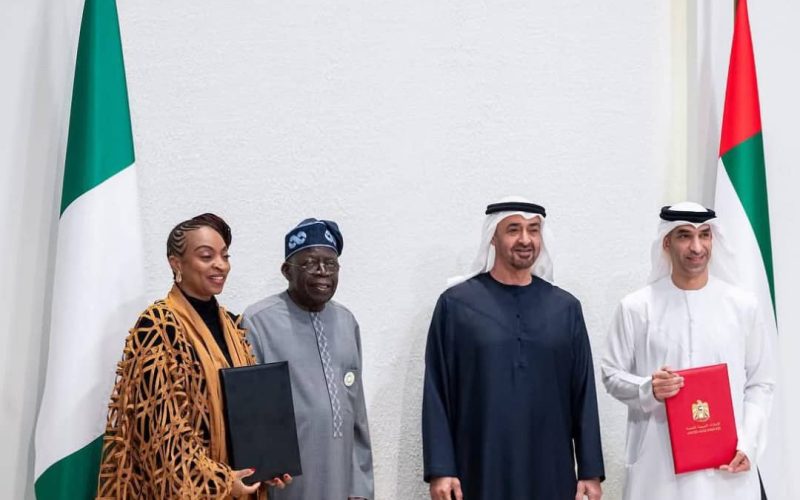
President Bola Ahmed Tinubu disclosed the plan at the 2026 Abu Dhabi Sustainability Week (ADSW), where Nigeria also concluded a Comprehensive Economic Partnership Agreement (CEPA) with the UAE to strengthen bilateral trade and cooperation across key growth sectors.
On the sidelines of the summit, President Tinubu and UAE President, Sheikh Mohamed bin Zayed Al Nahyan, witnessed the signing of the CEPA. The agreement was signed on behalf of Nigeria by the Minister of Industry, Trade and Investment, Dr. Jumoke Oduwole, while the UAE was represented by its Minister of Foreign Trade and Minister in charge of Talent Attraction and Retention, Dr. Thani bin Ahmed Al Zeyoudi.
Describing the pact as historic and strategic, President Tinubu said the CEPA would significantly expand cooperation in renewable energy, infrastructure, logistics, digital trade, aviation, agriculture and climate-smart infrastructure, while creating lasting opportunities for citizens of both countries.
In a statement issued by his Special Adviser on Information and Strategy, Mr. Bayo Onanuga, the President explained that Investopia would serve as a global platform bringing together investors, innovators, policymakers and business leaders to transform ideas into bankable and actionable investments.
“We warmly invite our partners to join us and help build the next chapter of sustainable and shared prosperity for Nigeria, Africa and the world,” the President said.
Addressing delegates at the summit, President Tinubu noted that the targeted $30 billion in green finance would help fast-track energy transition reforms, stressing that electricity remains the backbone of every modern economy.
He said Nigeria is committed to balancing industrialisation with decarbonisation, ensuring that economic growth does not come at the expense of environmental sustainability.
The President also called for reforms in the global financial architecture, urging a move away from restrictive sovereign guarantee requirements that often limit developing economies, and advocating blended finance and first-loss capital mechanisms to unlock private sustainable capital.
President Tinubu further disclosed that Nigeria has strengthened its climate governance framework through the adoption of a National Carbon Market Activation Policy and the launch of a National Carbon Registry, both aimed at improving transparency and boosting investor confidence.
He identified the Electricity Act 2023 as a cornerstone of Nigeria’s power sector reforms, explaining that it enables decentralised electricity generation and distribution, particularly in underserved communities.
According to the President, Nigeria’s climate investment agenda also includes a $500 million distributed renewable energy fund backed by the Nigeria Sovereign Investment Authority, alongside a $750 million World Bank programme expected to expand clean electricity access to over 17.5 million people.
Reaffirming Nigeria’s commitment to achieving net-zero emissions by 2060 under the Energy Transition Plan, President Tinubu said the country would continue to pursue industrial growth alongside universal energy access.
He also invited foreign investors to partner with Nigeria in the lithium and critical minerals sector, emphasising the government’s focus on local processing and value addition.
Highlighting the gains from ongoing economic reforms, the President said Nigeria has recorded a 21 per cent growth in non-oil exports, rising capital importation and over $50 billion in investment commitments across key sectors of the economy.
“These reforms, alongside broader fiscal and monetary measures, are yielding results. We are ready to work with partners across the world to ensure that the next era of development is green, inclusive, just and enduring,” President Tinubu said.
The Electricity Act 2023, which underpins the current power sector reforms, liberalises electricity generation and distribution, empowers states to regulate their own electricity markets, promotes renewable energy and strengthens consumer protection.
The Act also establishes new institutions such as the Nigeria Independent System Operator (NISO) for effective grid management, streamlines licensing processes, strengthens the Nigerian Electricity Regulatory Commission (NERC) and provides a decentralised framework for sustainable and affordable power access.
Under Section 230 of the Act, states are empowered to establish intrastate electricity markets and regulatory authorities, a provision made possible by the Fifth Alteration to the Nigerian Constitution, which moved electricity regulation from the Exclusive Legislative List to the Concurrent Legislative List.