





Southern Governors, Traditional Rulers Pass Vote Of Confidence In President Tinubu, Reaffirm Unity Amid Security Challenges
The Southern Governors Forum (SGF) and the Southern Nigeria Traditional Rulers Council, on Wednesday, jointly passed a Vote of Confidence in President Bola Ahmed Tinubu, commending his leadership and commitment to stabilising the nation amid rising security concerns.
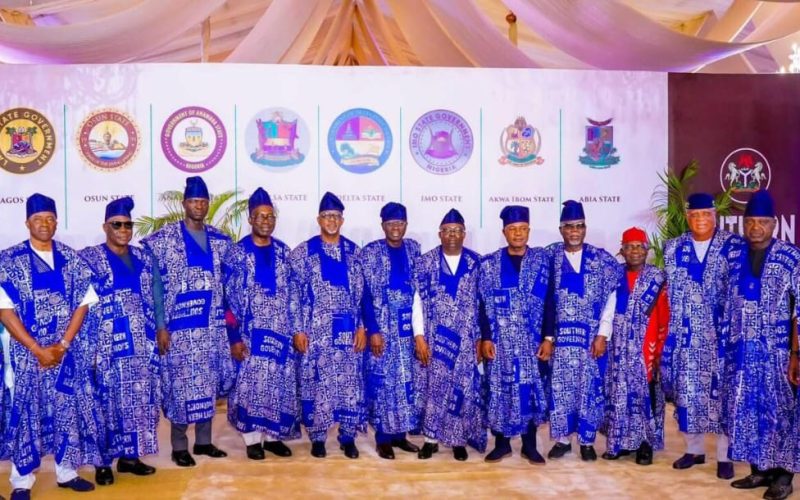
This was contained in a communiqué issued at the end of their joint meeting held in Ogun State and read by the host governor and SGF Chairman, Prince Dapo Abiodun.
The Forum expressed concern over what it described as deliberate attempts to destabilise the region through disinformation, fearmongering and the sowing of division. It reassured Nigerians that Southern Nigeria remains united, indivisible and firmly committed to peaceful coexistence across religious and cultural lines.
Reaffirming the region’s historic stance, the SGF recalled the Asaba Accord of May 2021, where Southern Governors unanimously advocated for a President of Southern extraction. The Forum reiterated its continued backing for a Southern presidency and, in particular, President Bola Ahmed Tinubu.
The meeting resolved to sustain a unified regional voice, advance the collective interests of the South, and deepen collaboration with the Federal Government to promote peace, prosperity and national development.
HIGH-LEVEL ATTENDANCE
Governor Dapo Abiodun hosted his colleagues including Governors Babajide Sanwo-Olu (Lagos), Siminalayi Fubara (Rivers), Alex Otti (Abia), Biodun Oyebanji (Ekiti), Francis Nwifuru (Ebonyi), Peter Mbah (Enugu), Charles Soludo (Anambra) and Lucky Aiyedatiwa (Ondo).
Deputy Governors present were Kola Adewusi (Osun), Bayo Lawal (Oyo), Peter Odey (Cross River) and Dennis Idahosa (Edo).
Traditional rulers in attendance included:
– The Dein of Agbor, Benjamin Ikenchukwu Keagborekuzi
– The Alake of Egbaland, Oba Adedotun Gbadebo
– The Akarigbo of Remoland, Oba Babatunde Ajayi
– The Olu of Ilaro, Oba Kehinde Olugbenle
– The Alaafin of Oyo, Oba Abimbola Akeem Owoade
– The Olota of Ota, Oba Adeyemi Obalanlege
among others.
Security chiefs from the Nigerian Army, Nigeria Police Force, DSS and NSCDC also attended, delivering sectoral briefings and highlighting challenges relating to equipment deficits, manpower shortages, intelligence integration and federal–state coordination.
KEY RESOLUTIONS
Following detailed deliberations on the regional security landscape, the Forum resolved as follows:
• Establishment of Zonal Security Funds:
Each geopolitical zone in the South is to set up a dedicated security fund, jointly financed by member states, to strengthen zonal operations and capacity-building. Monthly Zonal Security Coordination Meetings of State Security Advisers are to be institutionalised.
• Enhanced Intelligence and Communication Infrastructure:
The Forum adopted a unified intelligence-sharing framework supported by modern communication tools and surveillance technology for real-time monitoring and coordinated inter-state response. Member states will jointly invest in equipment enabling seamless communication across South-West, South-East and South-South boundaries.
• Renewed Advocacy for State Police:
The SGF reiterated its consistent call for constitutional approval of State Police, stressing that community-based and regional security outfits have demonstrated the necessity of decentralised policing.
• Unified Resident Identification System:
Southern states were encouraged to work with the National Identity Management Commission (NIMC) to implement a coordinated resident identification system to strengthen security and planning.
• Strengthening Regional and Local Security Structures:
Governments will enhance hunter groups, community surveillance units and other local security outfits through improved logistics, equipment and operational support.
• Governance of Land and Mining Activities:
States were urged to collaborate with traditional rulers to regulate land administration and curb indiscriminate allocation. The Forum also committed to combating illegal mining, citing its ecological risks, by partnering with environmental agencies and traditional institutions.
• Institutional Support for Traditional Councils:
Member states will provide financial and operational backing to traditional councils to boost their roles in governance, security and conflict resolution.
The joint meeting underscored a renewed era of regional collaboration anchored on unity, security cooperation and unwavering support for national stability under the Tinubu administration.


