


— President Swears In Two New Ministers, Reaffirms Commitment to Security, Economic Reform, and Global Partnerships
President Bola Ahmed Tinubu has declared that Nigeria’s economy is on a steady growth trajectory, with visible signs of stability and prosperity as his administration’s reforms continue to yield results and attract international confidence.
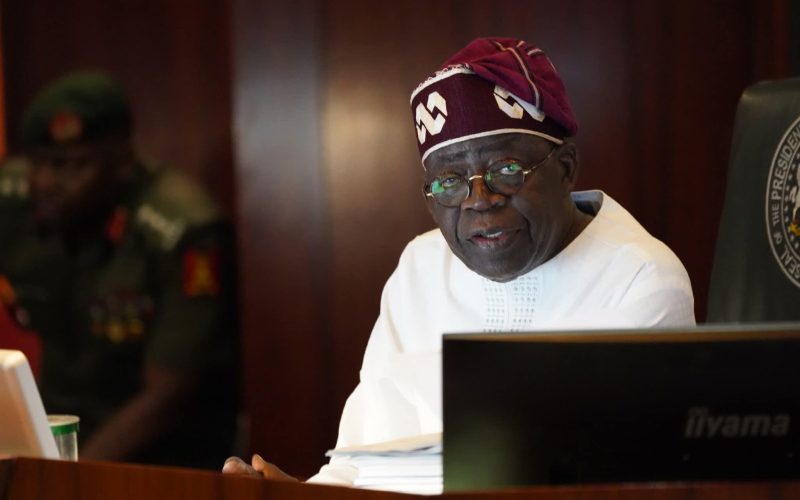
Speaking during the Federal Executive Council (FEC) meeting at the State House in Abuja on Thursday, shortly after swearing in Dr. Bernard Mohammed Doro as Minister of Humanitarian Affairs and Poverty Reduction and Dr. Kingsley Tochukwu Udeh (SAN) as Minister of Innovation, Science, and Technology, the President said the government remains committed to engaging the world diplomatically and strategically to advance national interests.
“The most important thing is that, despite political headwinds and public apprehension, we will continue to engage our partners globally. The success of the $2.3 billion Eurobond, which was oversubscribed by 400%, is most assuring,” President Tinubu said.
“The task ahead is immense, but we will face it with unity and purpose. Guided by the Renewed Hope Agenda, we are determined to build a prosperous, inclusive, and resilient Nigeria.”
ON SECURITY AND NATIONAL UNITY
President Tinubu, while reaffirming his commitment as Commander-in-Chief, urged Nigerians not to yield to fear or despair in the face of terrorism and insecurity.
“Yes, we have challenges, but we will defeat terrorism. We will overcome every negative label and restore Nigeria’s image. We are one happy family, and we will spare no effort until we eliminate every criminal element from our society,” he assured.
The President also cautioned his ministers and senior government officials to maintain message discipline, urging them to communicate government policies consistently and avoid conflicting narratives.
ECONOMIC GAINS AND REFORMS
During the session, the Minister of Finance and Coordinating Minister of the Economy, Wale Edun, briefed the Council on the nation’s improving macroeconomic indicators, noting that Nigeria recorded its best quarterly growth in a decade.
According to Edun:
“In Q2 2025, Nigeria’s GDP grew by 4.23%, the highest since the COVID rebound. Thirteen sectors grew above 7%, up from nine in the previous quarter. Industrial output almost doubled from 3.72% to 7.45%, reflecting productivity gains and investor confidence.”
He added that inflation had eased to 18.02% in September 2025, while foreign reserves rose to $43 billion and the trade surplus reached ₦7.4 trillion.
“Our citizens now spend about half of their income on basic needs — food, shelter, and clothing — compared to nearly 90% previously. This shows a transition from subsistence to productivity and affluence,” Edun noted.
NIGERIA’S GLOBAL CREDIBILITY RISING
The finance minister highlighted that Nigeria’s removal from the Financial Action Task Force Grey List signaled renewed confidence in the country’s financial integrity, while global institutions such as the IMF and World Bank have raised Nigeria’s growth forecast to nearly 4%.
He described the successful $2.35 billion Eurobond issuance, which attracted bids worth over $13 billion, as proof of strong investor faith in Nigeria’s reform agenda and Tinubu’s leadership.
“Despite political headwinds, markets focused on Nigeria’s economic fundamentals,” Edun said. “We must now deepen reforms, optimize every naira, and collaborate across all sectors — infrastructure, mining, agriculture, education, and digital innovation — to sustain the momentum.”
THE ROAD AHEAD
Reaffirming his administration’s determination to build a $1 trillion economy by 2030, President Tinubu urged ministers to ensure close collaboration with subnational governments, stressing that governance must translate into tangible impact for ordinary Nigerians.
“The world is watching our progress. We must continue to demonstrate that the Renewed Hope Agenda is not just a vision, but a national commitment to prosperity, stability, and pride for every Nigerian,” the President concluded.